
Vase
ca. 1880–85
Medium
Glazed earthenware
Dimensions
Greatest height: 5 3/8 in. (13.7 cm); Diameter: 4 7/8 in. (12.4 cm)
Classification
Ceramics-Pottery
Culture
French, Nancy
Department
European Sculpture and Decorative Arts
Museum
Metropolitan Museum of Art, New York, NY
Credit
Purchase, Bequests of John L. Cadwalader and Theodore M. Davis, by exchange, 1999
Accession Number
1999.398.1
Rights
Public Domain
Tags
Art Historical Context
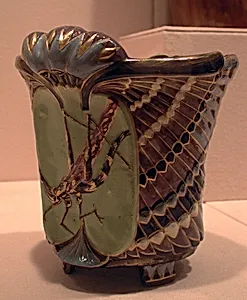
This delicate glazed earthenware vase by Émile Gallé, created around 1880–85, exemplifies the artist's early mastery of naturalistic forms during the formative years of the Art Nouveau movement. Hailing from Nancy, France—the epicenter of the École Nancy—Gallé drew inspiration from the organic world, often incorporating intricate motifs of flora and fauna. Measuring just 5⅜ inches tall and 4⅞ inches in diameter, this vessel likely features insect designs, a signature theme reflecting his fascination with nature's ephemeral beauty and intricate details. Gallé's work bridged historicism and modernism, revolutionizing decorative arts with techniques like pâte-de-verre and cameo cutting, though this earthenware piece highlights his experimentation in ceramics before his renowned glass innovations. The glossy glaze enhances the vase's subtle textures, evoking the iridescence of living creatures. Produced in Nancy's vibrant workshops, it embodies the school's emphasis on unity between art and industry, challenging the era's mass-produced goods. Today, housed in the Metropolitan Museum of Art's European Sculpture and Decorative Arts department, this vase offers a window into Gallé's evolution as a trailblazer, whose insect-adorned creations celebrated the poetry of the natural world amid France's fin-de-siècle cultural renaissance.