
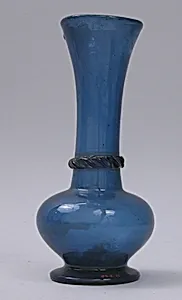
Vase
Unknown Artist
probably 18th–19th century
Medium
Glass, blue; free blown with applied decoration
Dimensions
H. 6 1/4 in. (15.9 cm) Max. Diam 2 15/16 in. (7.4 cm)
Classification
Glass
Department
Islamic Art
Museum
Metropolitan Museum of Art, New York, NY
Credit
Gift of Samuel L. M. Barlow, 1883
Accession Number
83.6.21
Rights
Public Domain
Art Historical Context
This delicate blue glass vase, likely crafted in the 18th or 19th century, the refined artistry of Islamic glassmakers from the Middle East or North Africa. Standing just 6¼ inches tall with a maximum diameter of nearly 3 inches, its slender form suggests it was designed for practical yet elegant use—perhaps holding perfumes, oils, or rosewater in a wealthy household. Housed in the Metropolitan Museum of Art's Art Department, it entered the collection in 1883 as a gift from collector Samuel L. M., highlighting early Western appreciation for Islamic decorative arts. The vase's creation showcases masterful free-blown glass techniques, where artisans gathered molten glass on a blowpipe and shaped it through skillful inflation, achieving fluid, organic contours without molds. Vibrant blue coloring, achieved with metal oxides like cobalt, was a hallmark of Islamic glass production, symbolizing the heavens or precious lapis lazuli. Applied decoration—trails or threads of glass meticulously affixed while hot—adds texture and visual interest, demonstrating the craftsmen's precision and the era's innovative experimentation amid Ottoman or Safavid influences. Though the artist remains unknown, this piece reflects the cultural flourishing of Islamic workshops, where glassware blended utility with beauty, influencing global design traditions. Visitors can admire its luminous translucency, a testament to enduring technical prowess.