
Vase d'Arezzo
Medium
Hard-paste porcelain, polychrome enamels, and gilding, with copper alloy mounts
Dimensions
H.: 85 cm (33 1/2 in.)
Classification
vase
Department
Applied Arts of Europe
Museum
Art Institute of Chicago
Accession Number
120061
Rights
Public Domain
Art Historical Context
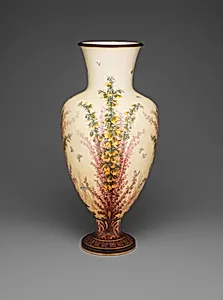
Step into the opulent world of 19th-century French porcelain the *Vase d'Arezzo*, crafted by the renowned Manufacture nationale de Sèvres 1884–85. Standing an impressive 85 cm (½ in.) tall, grand vessel exemplifies the pinnacle of European decorative arts. Made from durable hard-paste porcelain—a technically advanced material prized for its strength and translucency—the vase is adorned with vibrant polychrome enamels, gilding, and copper alloy mounts, likely adding handles or a base for both functionality and grandeur. Sèvres, the French national porcelain factory established in the 18th century, was a symbol of royal and imperial luxury, producing pieces for monarchs and collectors. This vase showcases masterful techniques: enamels fired at low temperatures to achieve rich, lasting colors; gilding for shimmering gold accents; and metal mounts evoking the opulent ormolu style of earlier eras. The title "d'Arezzo" nods to the ancient Italian city famous for Etruscan artifacts, suggesting a neoclassical revival that blended historic inspiration with modern virtuosity. Housed in the Art Institute of Chicago's Department of Applied Arts of Europe, the *Vase d'Arezzo* highlights porcelain's evolution from utilitarian ware to high art. It invites us to appreciate how such objects furnished the salons of the elite, merging artistry, technology, and cultural prestige in the Belle Époque.
About the Artist
Manufacture nationale de Sèvres · 1763–1800
The Manufacture nationale de Sèvres, a premier French porcelain factory, flourished from 1763 to 1800 as the royal powerhouse of European ceramics, producing opulent soft- and hard-paste porcelain under the patronage of Louis XV and XVI. Originally founded in Vincennes in 1740 to rival Meissen and Chantilly, it relocated to Sèvres in 1756 and was fully acquired by the Crown in 1759, becoming the M...