
元 景德鎮窯青白釉曲耳細頸瓶(一對)|Vase (one of a pair)
Unknown Artist
14th century
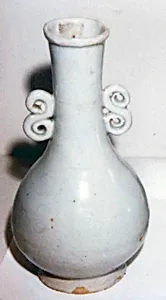
Medium
Porcelain with blue-white glaze (Qingbai ware)
Dimensions
H. 7 1/2 in. (19.1 cm); Diam. 3 3/4 in. (9.5 cm); Diam. of rim 1 5/8 in. (4.1 cm); Diam. of foot 2 5/8 in. (6.7 cm)
Classification
Ceramics
Culture & Period
China · Yuan dynasty (1271–1368)
Department
Asian Art
Museum
Metropolitan Museum of Art, New York, NY
Credit
Gift of Stanley Herzman, 1987
Accession Number
1987.247.2
Rights
Public Domain
Art Historical Context
This delicate pair of vases, produced in the 14th century at the renowned Jingdezhen kilns China's Yuan dynasty (12711368), exemplifies the of Qingbai ware—porcelain renowned for its subtle blue-white glaze. Standing just 7½ inches tall with slender necks, curved ear-like handles, and a graceful form, these vessels (one featured here) were likely used for floral arrangements or as incense holders, reflecting the refined tastes of the era under Mongol rule. Qingbai porcelain, fired at high temperatures to achieve its translucent, icy glaze, marked a technological pinnacle in Chinese ceramics. The Jingdezhen kilns, already a hub of innovation, produced this ware as a precursor to the famous blue-and-white porcelain of later dynasties, prized for its purity and subtle sheen that mimics jade. During the Yuan period, such objects symbolized luxury and cultural continuity amid political change, often exported along the Silk Road. Generously gifted to the Metropolitan Museum of Art by Stanley Herzman in 1987, this pair invites visitors to appreciate the understated beauty of Yuan craftsmanship—where form, glaze, and history converge in quiet splendor.