
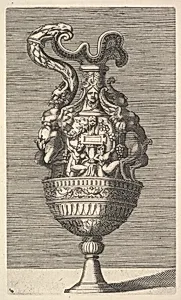
Vase with Two Winged Satyrs
Medium
Engraving
Dimensions
Sheet: 10 5/8 x 7 3/8 in. (27 x 18.8 cm) Plate: 7 3/8 x 4 3/8 in. (18.8 x 11.1 cm)
Classification
Prints|Ornament & Architecture
Department
Drawings and Prints
Museum
Metropolitan Museum of Art, New York, NY
Credit
Bequest of Phyllis Massar, 2011
Accession Number
2012.136.31
Rights
Public Domain
Tags
Art Historical Context
Behold the intricate *Vase with Two Wing Satyrs*, a 17th-century engraving that captures the whimsical spirit of classical mythology. This delicate print depicts an ornate vase adorned with a pair of playful, winged satyrs—half-human, half-goat creatures from Greek lore, symbols of revelry and nature's wild side. Rendered in fine lines on a modest plate measuring just 7 3/8 x 4 3/8 inches, it exemplifies the precision of engraving, a technique where metal plates are incised to hold ink, allowing for detailed reproductions ideal for widespread dissemination. Associated with a stellar roster of artists—including Dutch engravers Claes Jansz. Visscher and Frederick de Wit, alongside Renaissance masters like Polidoro da Caravaggio and Rosso Fiorentino—this work likely reproduces earlier Mannerist designs. Mannerism, with its elegant distortions and fantastical motifs, influenced 17th-century ornamental prints, which served as pattern books for silversmiths, ceramists, and architects. Classified under Prints: Ornament & Architecture at The Metropolitan Museum of Art, it reflects the era's fascination with "grotesques"—decorative fantasies inspired by ancient Roman frescoes unearthed during the Renaissance. Today, this bequest from Phyllis Massar invites us to appreciate how such prints bridged antiquity and the Baroque, fueling Europe's decorative arts revival. Imagine artisans across workshops copying these satyrs for grand vases or friezes, blending myth with everyday elegance.
About the Artist
Claes Jansz. Visscher|René Boyvin|Polidoro da Caravaggio|Rosso Fiorentino|Frederick de Wit · 1586–1652
Claes Jansz. Visscher, also known as Nicolas Joannis Visscher II or Joannis Piscator, was a prominent Dutch Golden Age draughtsman, engraver, mapmaker, and publisher born in Amsterdam in 1587 and died there on June 19, 1652. The son of the printmaker and publisher Jan Claesz. Visscher (c. 1550–1612), he learned the art of etching and printing from his father, helping to expand the family trade int...