
Velvet
Unknown Artist
16th–17th century
Dimensions
L. 3 3/4 x W. 4 inches (9.5 x 10.2 cm)
Classification
Textiles-Velvets
Culture
Italian
Department
European Sculpture and Decorative Arts
Museum
Metropolitan Museum of Art, New York, NY
Credit
Rogers Fund, 1909
Accession Number
09.50.132
Rights
Public Domain
Tags
Art Historical Context
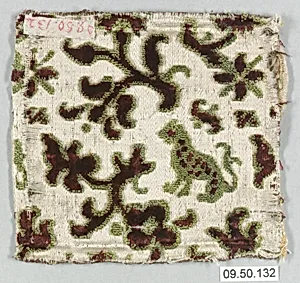
This exquisite fragment of Italian velvet, dating to the 16th or 17th century, showcases the pinnacle of Renaissance textile artistry from Italy's renowned weaving centers like Genoa or Florence. Measuring just 3¾ by 4 inches, this small yet opulent piece belongs to the Metropolitan Museum of Art's European Sculpture and Decorative Arts collection, acquired through the Rogers Fund in 1909. Its classification as a velvet textile highlights a luxurious material prized for its rich pile and shimmering surface, often woven from silk with intricate patterns. Featuring animal motifs—a common theme in period velvets—the design likely draws from symbolic or fantastical imagery popular in ecclesiastical vestments, noble garments, and furnishings. Italian velvet makers mastered complex techniques like cut-pile weaving and voiding, where ground and pattern areas were differentiated during production, creating depth and luminosity. These fabrics were status symbols, traded across Europe and beyond, embodying Italy's dominance in the luxury silk trade during the height of the Renaissance and early Baroque eras. Though the artist remains unknown, this velvet fragment offers a tactile glimpse into the opulence of early modern life, where textiles rivaled paintings in artistic prestige. Visitors can appreciate how such delicate works preserved cultural narratives through enduring craft.