
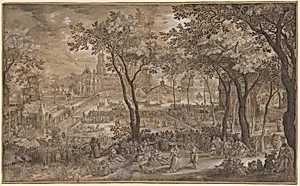
Venetian Party in a Chateau Garden
c. 1602
Medium
pen and brown ink, brown and gray wash, heightened with white on two sheets of paper joined vertically; incised for transfer; laid down
Dimensions
overall: 42.5 x 70.5 cm (16 3/4 x 27 3/4 in.)
Classification
Drawing
Department
CG-E
Museum
National Gallery of Art, Washington, D.C.
Credit
Gift of Robert H. and Clarice Smith
Accession Number
1986.76.1
Rights
Public Domain
Art Historical Context
David Vinckboons’s *Venetian Party in a Chateau Garden* captures the lively spirit of early seventeenth-century courtly entertainment. Created around 1602, the large drawing presents an elegant outdoor gathering set within a formal garden, complete with musicians, dancers, and richly dressed figures enjoying the pleasures of a summer afternoon. Though the title evokes Venice, the scene reflects the Flemish artist’s interest in idealized leisure, blending Northern European landscape traditions with imagined Italianate architecture and festivities. Executed in pen and brown ink with delicate washes and white heightening, the work demonstrates Vinckboons’s skill at suggesting light, texture, and depth on paper. The drawing was made on two joined sheets and incised for transfer, indicating it served as a preparatory design for a print—an important means of circulating such festive imagery across Europe at the time. Measuring over sixteen by twenty-seven inches, the composition rewards close looking, revealing both the artist’s lively draftsmanship and the social aspirations of his era. Now in the collection of the National Gallery of Art, this sheet offers viewers a vivid glimpse into how early modern artists transformed everyday enjoyment into lasting works of art.
About the Artist
David Vinckboons · 1576–1632
David Vinckboons (baptized 13 August 1576 – c. 1632) was a Flemish-born painter who became a pivotal figure in the Dutch Golden Age. Born in Mechelen in the Southern Netherlands, he was the son of Philips Vinckboons, a watercolor painter on canvas, under whom he studied as his sole teacher, according to Karel van Mander. The family fled religious turmoil, moving first to Antwerp around 1580, then ...