
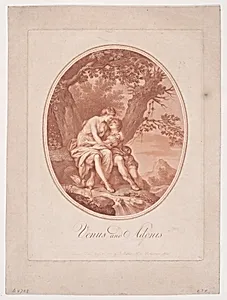
Venus and Adonis
August 21, 1778
Medium
Etching and stipple engraving; fourth state of nine
Dimensions
Plate: 9 15/16 × 7 1/2 in. (25.3 × 19 cm) Sheet: 12 9/16 × 9 1/8 in. (31.9 × 23.2 cm)
Classification
Prints
Department
Drawings and Prints
Museum
Metropolitan Museum of Art, New York, NY
Credit
Harris Brisbane Dick Fund, 1917
Accession Number
17.3.3131
Rights
Public Domain
Art Historical Context
In the lush tradition of classical mythology, *Venus and Adonis* captures the tender romance between the goddess of love and her mortal hunter, a tale immortalized by Ovid and Titian. Created on August 21, 1778, this print unites the talents of Italian engraver Francescoolozzi, English miniaturist Richard Coswaylikely the designer), and J. Walker. Housed in the Metropolitan Museum of Art's Drawings and Prints, it exemplifies the collaborative artistry of 18th-century Britain, where reproductive prints brought high-society paintings to wider audiences. The medium—etching and stipple engraving in its fourth state of nine—highlights innovative printmaking techniques. Stipple, Bartolozzi's specialty, uses fine dots to mimic the soft, painterly glow of oil paintings, ideal for evoking Venus's sensuous form and Adonis's youthful beauty. Measuring about 10 by 7.5 inches on the plate, this intimate scale suited collectors' albums, blending technical precision with rococo elegance during the late Enlightenment. Acquired through the Harris Brisbane Dick Fund in 1917, this work reflects the era's fascination with antique myths amid growing neoclassical tastes. It invites visitors to appreciate how prints democratized art, turning elite fantasies into accessible treasures.
About the Artist
Francesco Bartolozzi|Richard Cosway|J. Walker · 1727–1815
Francesco Bartolozzi (1727–1815) was an Italian engraver whose most productive period was spent in London, where he became the leading exponent of stipple engraving and a founding member of the Royal Academy. Born in Florence and trained first as a painter before turning to engraving in Venice, he established his reputation in Rome before being recruited by the English Royal Librarian Richard Dalt...