
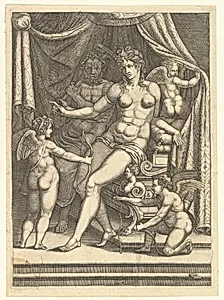
Venus and Vulcan Seated on a Bed and Three Putti
Medium
Engraving
Dimensions
plate: 11 1/4 x 8 1/8 in. (28.6 x 20.7 cm) sheet: 11 11/16 x 8 1/2 in. (29.7 x 21.6 cm)
Classification
Prints
Department
Drawings and Prints
Museum
Metropolitan Museum of Art, New York, NY
Credit
Harris Brisbane Dick Fund, 1947
Accession Number
47.100.1275
Rights
Public Domain
Tags
Art Historical Context
This engraving captures a lively mythological scene of Venus, the goddess of love, and her husband Vulcan, the god of fire, seated intimately on a bed. Three playful putti, including Cupid with his bow, surround the couple, adding a sense of joyful energy to the composition. Created in the mid-1550s, the work reflects the enduring Renaissance fascination with classical myths reimagined through a Mannerist lens. The design originates from Perino del Vaga, a leading Mannerist artist who trained under Raphael and brought elegant, elongated figures and graceful movement to his compositions. Giorgio Ghisi, a skilled engraver from Mantua, translated this vision into print, using fine lines and delicate shading to convey texture and depth. Such reproductive engravings played a vital role in spreading artistic ideas across Europe during the 16th century, allowing collectors and artists far from Italy to study celebrated designs. Housed in the Metropolitan Museum of Art’s Department of Drawings and Prints, this work exemplifies how printmaking bridged painting and popular culture, making mythological stories accessible to a broader audience while preserving the refined style of its creators.
About the Artist
Giorgio Ghisi|Perino del Vaga (Pietro Buonaccorsi) · 1520–1582
Giorgio Ghisi (c. 1520–1582) was one of the most accomplished engravers of the Italian Renaissance, renowned for translating the monumental compositions of Raphael, Giulio Romano, and Michelangelo into the exacting medium of the burin. Born in Mantua, he trained in an environment shaped by the legacy of Giulio Romano's decoration of the Palazzo del Te, and the grandeur of that Mannerist tradition ...