
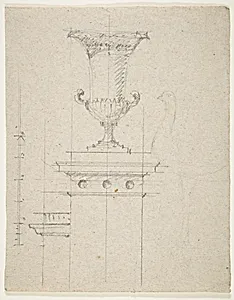
verso: Design for an urn; recto: Designs for two urns
19th century
Medium
Black chalk on laid paper
Dimensions
sheet: 9 13/16 x 7 13/16 in. (25 x 19.8 cm)
Classification
Drawings
Department
Drawings and Prints
Museum
Metropolitan Museum of Art, New York, NY
Credit
Gift of János Scholz, 1961
Accession Number
61.636.46
Rights
Public Domain
Tags
Art Historical Context
This delicate drawing, created by an anonymous French artist in the 19th century captures the elegance of classical urn designs on both sides of a sheet. Titled *verso: Design for an urn; recto: Designs for two urns*, the work showcases intricate sketches likely intended as preparatory studies for decorative objects, reflecting the period’s fascination with neoclassical motifs drawn from ancient Greek and Roman sources. Such were common in French workshops, where artisans translated two-dimensional ideas into vases, garden ornaments, or memorial pieces that adorned homes and public spaces. Executed in black chalk on laid paper, the medium allows for soft shading and precise line work that highlights the urns’ graceful silhouettes and ornamental details. Measuring just under 10 by 8 inches, the compact sheet reveals the’s thoughtful exploration of form and proportion, offering a glimpse into the creative process behind 19th-century decorative arts. Now part of the Metropolitan Museum of Art’s Drawings and Prints collection, this piece was generously gifted by János Scholz in 1961, preserving a quiet yet insightful record of anonymous craftsmanship from a transformative era in French design.
About the Artist
Anonymous, French, 19th century · 1800–1900
**Anonymous, French, 19th Century (ca. 1800–1900)** The artist cataloged as Anonymous, French, 19th century embodies the enigmatic yet essential contributions of unidentified creators to France's vibrant 19th-century art world. Active roughly between 1800 and 1900, this figure—or potentially collective workshop—produced a diverse array of works amid the nation's transition from Neoclassicism thro...