
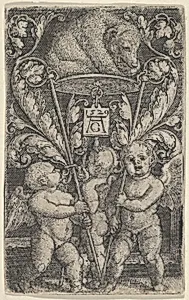
Vertical Panel with Three Winged Boys Carrying a Bear on a Tray
Medium
Engraving
Dimensions
Sheet: 2 1/2 × 1 5/8 in. (6.4 × 4.1 cm)
Classification
Prints|Ornament & Architecture
Department
Drawings and Prints
Museum
Metropolitan Museum of Art, New York, NY
Credit
Rogers Fund, 1962
Accession Number
62.656.8
Rights
Public Domain
Tags
Art Historical Context
In the Metropolitan Museum of Art's Drawings and Prints department, Heinrich Aldegrever's *Vertical Panel with Three Winged Boys Carrying a Bear on Tray* (1529) captivates with its whimsical engraving. Aldegrever, a of the German "Little Masters"—printmakers famed for intricate small-scale works—crafted this tiny gem, measuring just 2½ × 1⅝ inches. Created during the Northern Renaissance amid the early Reformation, it exemplifies the era's fascination with ornamental designs for architecture and decorative arts, blending fantasy with precise craftsmanship. The composition features three playful putti—those cherubic, winged boys ubiquitous in Renaissance motifs—hoisting a bear atop a tray in a vertical panel format. This fantastical scene likely served as a model for larger ornamental friezes or panels, showcasing engraving's power to render fine details like feathers, fur, and dynamic poses on a metal plate inked and pressed onto paper. Bears evoke folklore and heraldry, adding humor and symbolism to the putti's joyful labor. Aldegrever's technique highlights the medium's revolutionary reproducibility, disseminating decorative ideas across workshops. Acquired through the Rogers Fund in 1962, this print invites visitors to marvel at how Renaissance ingenuity turned the miniature into the monumental.
About the Artist
Heinrich Aldegrever · 1502–1561
Heinrich Aldegrever, born in 1502 in Paderborn, Westphalia, to parents Herman and Katherine Trippenmeker—a family of clog-makers known by the dialect name Trippenmecker—emerged as a multifaceted artist in the German Renaissance. His early training remains undocumented, though he likely apprenticed in a Soest goldsmith's workshop after relocating there around 1525, where he joined the painters' gui...