
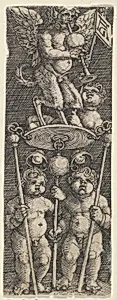
Vertical Panel with Two Children Supporting a Pedestal with a Satyr Playing a Bagpipe
ca. 1527
Medium
Engraving
Dimensions
Sheet: 2 15/16 × 1 1/8 in. (7.5 × 2.8 cm)
Classification
Prints|Ornament & Architecture
Department
Drawings and Prints
Museum
Metropolitan Museum of Art, New York, NY
Credit
The Elisha Whittelsey Collection, The Elisha Whittelsey Fund, 1960
Accession Number
60.621.26
Rights
Public Domain
Tags
Art Historical Context
Heinrich Aldegrever, a prominent German engraver of the Northern Renaissance and one of the "Little Masters known for their intricate small-scale works, created this *Vertical Panel with Two Children Supporting a Pedestal with ayr Playing a Bagpipe around 1527. as an engraving on a diminutive sheet measuring just 2 15/16 × 1 1/8 inches, it exemplifies the precision of the medium, where Aldegrever incised fine lines into a copper plate to produce detailed, reproducible designs. Housed in the Metropolitan Museum of Art's Drawings and Prints department, this piece was acquired through The Elisha Whittelsey Collection in 1960. The composition features two playful children hoisting a pedestal upon which a mischievous satyr pipes away on a bagpipe, blending classical mythology with Renaissance ornamentation. Such prints were highly valued in the 16th century as pattern books for artisans—goldsmiths, woodcarvers, and textile designers—who adapted these motifs for furniture, jewelry, and architecture. The satyr, a symbol of revelry from Greco-Roman lore, adds a whimsical, musical flair, while the children evoke innocence supporting rustic joy. Aldegrever's mastery shines in the delicate cross-hatching and fluid lines that convey texture and movement within such a tiny format, making it a gem of ornamental printmaking. This work highlights the era's fascination with grotesque and fantastical elements, bridging fine art and craft in a delightful, functional way.
About the Artist
Heinrich Aldegrever · 1502–1561
Heinrich Aldegrever, born in 1502 in Paderborn, Westphalia, to parents Herman and Katherine Trippenmeker—a family of clog-makers known by the dialect name Trippenmecker—emerged as a multifaceted artist in the German Renaissance. His early training remains undocumented, though he likely apprenticed in a Soest goldsmith's workshop after relocating there around 1525, where he joined the painters' gui...