
Vertumnus en Pomona
Medium
oil on canvas
Dimensions
90; 149.5
Rights
Public Domain
About this artwork
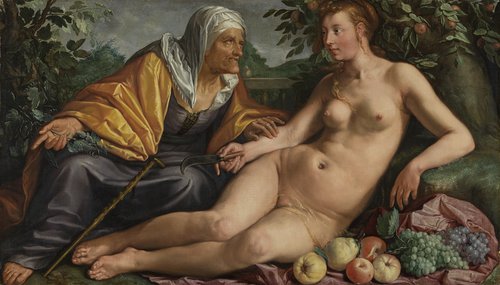
Vertumnus en Pomona. Vertumnus, in de gedaante van een oude vrouw, spreekt zijn geliefde, de naakte Pomona, toe. Vertumnus grijpt met haar rechterhand een wijnrank. Tussen haar benen ligt haar wandelstok. Pomona ligt onder een appelboom en houdt in haar rechterhand een soort snijmesje waarmee zij fruit oogstte. Rechts op de voorgrond liggen appels, peren en druiven.
Art Historical Context
Hendrick Goltzius’s *Vertumnus en Pomona* (1613) captures a pivotal moment from Ovid’s *Metamorphoses*, in which the shape-shifting god Vertumnus, disguised as an elderly woman, woos theclusive orchard goddess Pomona. Oil on canvas measuring 90 by 149.5 centimeters, the painting places the viewer in an intimate bower beneath an apple tree. Vertumnus gestures animatedly with one hand clutching a grapevine while her staff rests between her legs; Pomona, nude and relaxed, holds a small pruning knife, surrounded by ripe apples, pears, and grapes. Goltzius, celebrated earlier for his virtuoso engravings, turned increasingly to painting in his later years. Here he employs rich, glowing colors and smooth brushwork to emphasize the contrast between the crone’s weathered features and Pomona’s luminous skin, heightening the drama of disguise and revelation. The abundant fruit and vine underscore themes of fertility and seasonal change central to the myth. Displayed in the Rijksmuseum, the work reflects the Dutch interest in classical mythology during the Golden Age, inviting viewers to appreciate both the sensual beauty of the figures and the clever narrative tension Goltzius so skillfully conveys.
About the Artist
Hendrick Goltzius · 1558–1617
Hendrick Goltzius (1558–1617) was the most celebrated engraver of the Northern Renaissance and a pivotal figure in Dutch Mannerism. Born near the German-Dutch border, Goltzius transformed printmaking into a virtuoso art form through his revolutionary 'swelling line' technique, where the burin was manipulated to create lines of varying thickness that produced unprecedented tonal effects and three-d...