
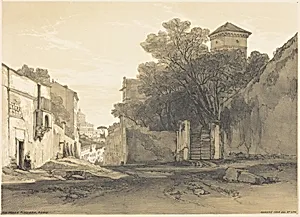
Via Porta Pinciana, Rome
1801 to 1825
Medium
color lithograph
Dimensions
sheet: 33.7 × 46.8 cm (13 1/4 × 18 7/16 in.)
Classification
Department
CG-E
Museum
National Gallery of Art, Washington, D.C.
Credit
Gift of Miss Katharine Shepard
Accession Number
1975.102.2
Rights
Public Domain
Art Historical Context
Step into the sunlit streets of Rome with Edward Lear's *Via Porta Pinciana, Rome*, a captivating color lithograph that transports visitors to the Eternal City's vibrant urban life. Lear, the beloved British artist and nonsense poet (1812–8), was a masterful illustrator whose keen eye for topography shone in his detailed travel sketches. Though best remembered for limericks like "The Owl and the Pussycat," Lear's visual works, produced during his extensive European wanderings, beautifully preserve architectural grandeur and everyday scenes from the early 19th century. This print, dated between 1801 and 1825, exemplifies the rise of color lithography—a revolutionary technique invented around 1798 that allowed artists to transfer intricate drawings from stone to paper with remarkable fidelity and hue. Measuring 33.7 × 46.8 cm, its vivid tones capture the Via Porta Pinciana, a bustling thoroughfare near the ancient Porta Pinciana gate, evoking the Romantic era's fascination with Italy during the Grand Tour. As part of the National Gallery of Art's Prints collection (Department CG-E), gifted by Miss Katharine Shepard, it offers a window into Rome's neoclassical charm and Lear's precise, atmospheric style. Today, this work highlights lithography's role in democratizing art, making grand vistas accessible beyond oil paintings, and invites us to linger on Rome's timeless allure.
About the Artist
Edward Lear · 1812–1888
Edward Lear (1812–1888) was a British artist, illustrator, author, and poet whose creative output ranged from meticulous natural history illustration to landscape painting and the beloved comic verse of his limericks and nonsense poetry. Born in London as the twentieth of twenty-one children, Lear largely educated himself as a draughtsman and began his professional career illustrating parrots for ...