
Victoria # 1050
ca. 1870
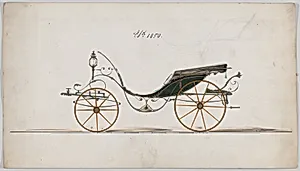
Medium
Pen and black ink, watercolor and gouache with gum arabic and metallic ink
Dimensions
Sheet: 6 1/8 x 10 3/4 in. (15.6 x 27.3 cm)
Classification
Drawings
Department
Drawings and Prints
Museum
Metropolitan Museum of Art, New York, NY
Credit
Gift of William Brewster, 1923
Accession Number
23.112.3071
Rights
Public Domain
Tags
Art Historical Context
Step into the refined world of 19th luxury transport with *Victoria #1050*, a exquisite design drawing by the renowned New York carriage makers Brewster & Co., circa 1870. This rendering depicts a sleek Victoria carriage—a light, four-wheeled open vehicle favored by the elite for leisurely drives, named after Queen Victoria herself. Produced during America's Gilded Age, when opulent horse-drawn conveyances symbolized wealth and status, Brewster & Co crafted bespoke vehicles for luminaries like the Vanderbil and Astors, blending British elegance with American innovation. The artwork's artistic significance lies in its masterful use of mixed media: pen and black ink for precise lines, watercolor and gouache for vibrant hues, gum arabic for a glossy sheen, and metallic ink to evoke the gleam of polished brass fittings and wheels. At just 6 1/8 x 10 3/4 inches, this sheet from the Metropolitan Museum of Art's Drawings and Prints department captures the carriage's intricate details—from tufted upholstery to ornate lanterns—serving as both a sales catalog illustration and a testament to the firm's design prowess. A gift to the Met in 1923 by William Brewster, this piece offers a glimpse into a vanishing era, just before automobiles reshaped mobility, highlighting how fine draftsmanship elevated everyday objects to art.
About the Artist
Brewster & Co. · 1837–present
**Brewster & Co.** Brewster & Company, a premier American coachbuilder renowned for its exquisite carriage designs, was established in 1810 in New Haven, Connecticut, by James Brewster (1788–1866). Born in 1788, Brewster trained as a wagonmaker's apprentice starting at age 16 in Northampton, Massachusetts, before relocating to New Haven, where he set up his workshop and quickly gained acclaim for...