
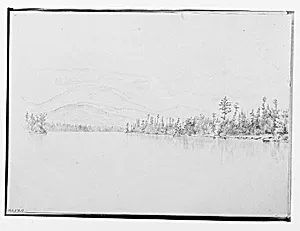
View Across A Lake or River to Mountains (from Sketchbook)
ca. 1860–ca. 1864
Medium
Graphite, watercolor, on beige paper
Dimensions
9 3/4 x 13 7/8 in. (24.8 x 35.2 cm)
Classification
Watercolor
Culture
American
Department
The American Wing
Museum
Metropolitan Museum of Art, New York, NY
Credit
Purchase, Sheila and Richard J. Schwartz Fund and Gifts in memory of Stephen D. Rubin, 1992
Accession Number
1992.373.17
Rights
Public Domain
Tags
Art Historical Context
Thomas Hewes Hinck *View Across A Lake or to Mountains*, created around 1860–1864, offers a serene glimpse into the American Romantic tradition of landscape art. Drawn from his sketchbook this intimate study captures a tranquil vista of reflective waters leading to distant, majestic peaks, framed by trees. Rendered in graphite and watercolor on beige paper (9 3/4 x 13 7/8 in.), it exemplifies artist's keen eye for nature's subtle moods during a pivotal era—the American Civil War—when many artists sought solace and grandeur in the wilderness. Hinckley, an American painter known for his luminous landscapes, employed these portable mixed media to swiftly record fleeting light and atmospheric effects en plein air, a technique bridging studio work and direct observation. The watercolor's delicate washes evoke depth and serenity, while graphite adds precise contours, highlighting the Hudson River School's influence on celebrating America's sublime scenery amid national turmoil. Housed in The Metropolitan Museum of Art's American Wing, this piece—acquired in 1992—reminds us of 19th-century artists' passion for preserving ephemeral beauty. It's a testament to how sketchbooks fueled larger canvases, inviting viewers to ponder the timeless allure of lakes, mountains, and trees.
About the Artist
Thomas Hewes Hinckley · 1813–1896
Thomas Hewes Hinckley (1813–1896) was an American painter who became one of the leading specialists in animal painting in the United States during the mid-nineteenth century. Born in Milton, Massachusetts, he was largely self-taught in his early years, developing his skills through sustained observation of animals in the field and study of European masters whose work he encountered in reproduction...