
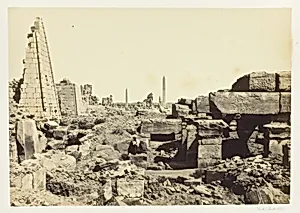
View at Karnac, from the Granite Pylon
1857
Medium
Albumen print, pl. 2 from the album "Egypt and Palestine, Volume II" (1858/60)
Dimensions
Image/paper: 16 × 22.6 cm (6 5/16 × 8 15/16 in.); Album page: 29.8 × 42.7 cm (11 3/4 × 16 13/16 in.)
Classification
albumen silver print
Department
Photography and Media
Museum
Art Institute of Chicago
Accession Number
157971
Rights
Public Domain
Art Historical Context
Step into the ancient grandeur of Karnak with Francis Frith's *View at Karnac, the Granite Pylon* (1857), an exquisite albumen silver print from renowned album *Egypt and Palestine Volume II* (185/60). Captured from atop a towering granite pylon at the Karnak Temple Complex in Luxor, Egypt—one of the largest religious sites in the ancient world—this photograph offers a sweeping vista of colossal columns, hypostyle halls, and hieroglyph-covered ruins, evoking the awe of pharaonic Egypt. Frith, a pioneering British photographer and entrepreneur, ventured into the Middle East in the 1850s, hauling bulky cameras and chemicals across deserts to document these timeless wonders. His albumen prints, made by coating paper with egg-white albumen and sensitizing it with silver salts, delivered the sharp detail and warm tones that captivated Victorian audiences, making distant antiquities accessible through affordable, beautifully bound albums. This plate (pl. 2) exemplifies early travel photography's blend of artistry and ethnography. Held in the Art Institute of Chicago's Photography and Media Department, this 16 × 22.6 cm image (on a larger album page) not only preserves a 19th-century gaze on Egypt's past but also highlights photography's role in fueling Western fascination with Orientalism and archaeology during the colonial era. A window to history, indeed!
About the Artist
Francis Frith · 1822–1898
Francis Frith (1822–1898) was born on 7 October 1822 in Chesterfield, Derbyshire, into a prosperous Quaker merchant family as the second child and only son of Francis Frith Sr. and Alice Walker. Educated at Quaker schools including Ackworth and Camp Hill in Birmingham from around 1828 to 1838, he apprenticed in the cutlery trade before establishing himself as a wholesale grocer in Liverpool, suppl...