
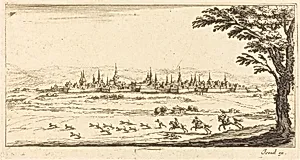
View of Nancy
in or after 1635
Medium
etching on laid paper
Dimensions
plate: 8.9 × 6.9 cm (3 1/2 × 2 11/16 in.) sheet (irreg.): 11.6 × 20.8 cm (4 9/16 × 8 3/16 in.)
Classification
Department
CG-E
Museum
National Gallery of Art, Washington, D.C.
Credit
R.L. Baumfeld Collection
Accession Number
1969.15.11
Rights
Public Domain
Art Historical Context
This delicate etching, titled *View of Nancy*, captures a charming glimpse of the historic French city that was home to the celebrated printmaker Jacques Callot. Created after Callot’s design in or after 1635—the year of the artist’s death—the print reflects the enduring popularity of his work. Though small in scale, measuring just under four inches in height, the image demonstrates the precision and lively detail for which Callot was renowned. Callot, a master of 17th-century etching, frequently turned his attention to the architecture and daily life of Nancy in the Duchy of Lorraine. This print, produced on laid paper using the etching technique, showcases his ability to suggest bustling urban spaces within a compact format. The irregular sheet size hints at its origins as a study or collector’s piece rather than a large formal edition. Today housed in the National Gallery of Art’s collection as part of the R.L. Baumfeld gift, the work offers modern viewers an intimate connection to both Callot’s artistic legacy and the cultural landscape of early modern France. Its modest dimensions invite close looking, rewarding the viewer with the intricate line work that made Callot’s views so influential.
About the Artist
after Jacques Callot
**Jacques Callot (c. 1592–1635)**, the master whose designs inspired the works attributed "after Jacques Callot," was a pioneering French Baroque printmaker and draftsman born in Nancy, capital of the independent Duchy of Lorraine (now northeastern France). From a noble family—his father served as master of ceremonies and herald-at-arms to the Duke of Lorraine—young Callot was apprenticed to a gol...