
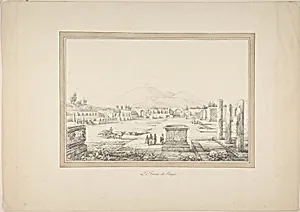
View of Pompeii
19th century
Medium
Pen and black and gray ink
Dimensions
sheet: 10 1/8 x 13 9/16 in. (25.7 x 34.5 cm)
Classification
Drawings
Department
Drawings and Prints
Museum
Metropolitan Museum of Art, New York, NY
Credit
Gift of Mrs. Francis L. Noble, 1935
Accession Number
35.37.6
Rights
Public Domain
Tags
Art Historical Context
This delicate pen and black ink drawing, titled *View of Pompeii*, a poignant glimpse into the ancient city's haunting ruins, captured by an anonymous French artist in the 19 century. Measuring just over 10 by 13 inches, the sheet belongs to the Metropolitan Museum of's Drawings and Prints collection gifted in 1935. Its intimate scale invites viewers to lean in, tracing the weathered arches and crumbled walls frozen in time. Pompeii's allure exploded in the 19th century, following its rediscovery and ongoing excavations after the catastrophic eruption of Mount Vesuvius in 79 AD. European travelers, especially during the Grand Tour era, flocked to the site, fueling Romantic fascination with antiquity, decay, and the sublime power of nature. French artists, in particular, documented these scenes with a keen eye for historical drama, blending archaeological precision with emotional resonance. The use of pen and black and gray ink exemplifies 19th-century draftsmanship, where fine lines and subtle washes create depth and texture. This technique highlights the ruins' stark contrasts—shadowy voids against faint light—evoking a sense of melancholy discovery. A testament to travel sketching, it reminds us how such works preserved vanishing worlds for armchair explorers everywhere.
About the Artist
Anonymous, French, 19th century · 1800–1900
**Anonymous, French, 19th Century (ca. 1800–1900)** The artist cataloged as Anonymous, French, 19th century embodies the enigmatic yet essential contributions of unidentified creators to France's vibrant 19th-century art world. Active roughly between 1800 and 1900, this figure—or potentially collective workshop—produced a diverse array of works amid the nation's transition from Neoclassicism thro...