
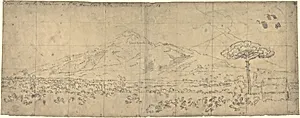
View of Vesuvius
August 18 [1782]
Medium
Graphite on tracing paper
Dimensions
Sheet: 7 1/2 × 18 7/8 in. (19 × 48 cm)
Classification
Drawings
Department
Drawings and Prints
Museum
Metropolitan Museum of Art, New York, NY
Credit
Rogers Fund, 1907
Accession Number
07.282.4
Rights
Public Domain
Tags
Art Historical Context
John Robert Cozens, a British draftsman celebrated for his luminous landscapes, captured the dramatic *View of Vesuvius on August 18, 1782, during his Grand Tour travels through Italy. This panoramic graphite drawing on tracing paper—measuring a slender yet expansive 7½ × 18⅞ inches—evokes the awe-inspiring power of Mount Vesuvius the infamous volcano looming near Naples. Cozens, whose works bridged neoclassicism and emerging Romanticism, excelled at conveying nature's sublime scale, blending rugged volcanic forms with sweeping landscapes and foreground trees. The use of tracing paper highlights Cozens's innovative technique: lightweight and translucent, it allowed for precise on-site sketching and later refinements or tracings into watercolors, for which he was renowned. These intimate studies were prized by collectors like his patron Richard Payne Knight, influencing later artists such as J.M.W. Turner in their pursuit of atmospheric depth and emotional resonance. Today, housed in the Metropolitan Museum of Art's Drawings and Prints department (acquired via the Rogers Fund in 1907), this piece invites us to ponder Vesuvius's enduring mystique—site of the cataclysmic 79 AD eruption that buried Pompeii—reminding visitors of art's power to freeze fleeting moments of natural grandeur.