
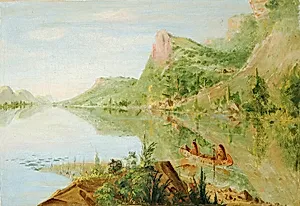
View on the Wisconsin River, Winnebago Shooting Ducks
1836-1837
Medium
Painting
Classification
Painting
Department
Smithsonian Collection
Museum
Smithsonian American Art Museum
Credit
Smithsonian American Art Museum, Gift of Mrs. Joseph Harrison, Jr.
Accession Number
1985.66.347
Rights
Public Domain
Tags
About this artwork
In the summer of 1836, George Catlin made his final journey to the West, to visit the sacred Pipestone Quarry in present-day Minnesota, where Plains Indians harvested the red steatite to make their pipe bowls. He journeyed west by steamer from New York through Sault Ste. Marie and Green Bay, paddling down the Wisconsin River, where he sketched this image of Winnebago Indians hunting ducks. Although familiar with the West’s stunning landscape since beginning his travels in 1830, Catlin found the ...
Art Historical Context
In the summer of 1836, George Catlin, the pioneering American artist renowned for his vivid documentation of Native American life and the untamed West, embarked on his final major journey westward. Traveling by steamer from New York throughault Ste. Marie and Bay, he paddled down the Wisconsin River en route to the sacred Pip Quarry in present-day Minnesota. There, he sketched *View on the Wisconsin River Winnebago Shooting Ducks capturing Winnebago (Ho-Chunk) hunters in action amid the river's pristine beauty. This oil painting exemplifies Catlin's Romantic style, blending keen observation with a deep reverence for the American frontier. He marveled at the Wisconsin River's "beautifully skirted banks and prairie bluffs," calling it "La belle riviere"—a beauty rivaling the Mississippi itself. Painted during a time of rapid westward expansion, the work preserves a fleeting moment of indigenous daily life, highlighting the harmony between Winnebago people, wildlife like ducks, and the landscape before cultural disruptions intensified. Catlin's enthusiasm for these scenes fueled his lifelong mission to portray the "noble" West, making this piece a poignant artifact in the Smithsonian American Art Museum's collection. It invites visitors to reflect on America's vanishing wilderness and the enduring legacy of its first peoples.
About the Artist
George Catlin · 1796–1872
George Catlin (1796–1872), born in Wilkes-Barre, Pennsylvania, to Putnam Catlin and Polly Sutton—who had been captured by Native Americans during the 1778 Battle of Wyoming—initially pursued a legal career. Trained at Litchfield Law School, he was admitted to the bar in 1819 but abandoned law after two years to study art in Philadelphia in 1823. Self-taught as a portraitist, Catlin quickly gained ...