
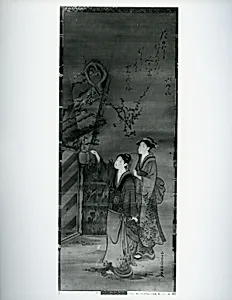
Viewing Plum Blossoms at Night
dated 1780
Medium
Ink and color on silk
Dimensions
29 7/8 x 11 11/16 in. (75.9 x 29.7 cm)
Classification
Paintings
Culture & Period
Japan · Edo period (1615–1868)
Department
Asian Art
Museum
Metropolitan Museum of Art, New York, NY
Credit
Charles Stewart Smith Collection, Gift of Mrs. Charles Stewart Smith, Charles Stewart Smith Jr., and Howard Caswell Smith, in memory of Charles Stewart Smith, 1914
Accession Number
14.76.49
Rights
Public Domain
Tags
Art Historical Context
**Viewing Plum Blossoms at Night** (1780) by Kubo Shunman captures the poetic elegance of Edo-period Japan, a time of cultural flourishing under the Tokugawa shogunate (1615–1868). Shunman, a versatile ukiyo-e artist known for his refined depictions of the "floating world" of urban pleasures, renders women savoring the delicate beauty of plum blossoms under moonlight. Plum blossoms, Japan's harbingers of spring, symbolize resilience and renewal, often celebrated in nighttime gatherings by the literati and pleasure quarters alike. Painted in ink and color on silk—a luxurious medium prized for its luminous sheen and ability to hold subtle gradations—this hanging scroll exemplifies traditional Japanese brushwork. The narrow format (29 7/8 x 11 11/16 in.) invites intimate contemplation, with fluid lines and soft washes evoking a serene nocturnal atmosphere. Shunman's mastery blends realism and lyricism, highlighting the women's graceful kimonos and the ethereal glow of lanterns amid blooming branches. Housed in the Metropolitan Museum of Art's Asian Art collection, this work reflects the era's fascination with refined leisure and nature's fleeting beauty. A gift from the Charles Stewart Smith family in 1914, it offers visitors a window into Japan's vibrant artistic heritage, where art and poetry intertwined to honor life's ephemeral joys.
About the Artist
Kubo Shunman · 1757–1820
Japanese, 1757–1820