
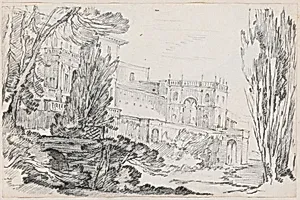
Villa d'Este, Tivoli
1744/1750
Medium
graphite on laid paper
Dimensions
sheet: 11.9 x 18 cm (4 11/16 x 7 1/16 in.) page size: 42.5 x 27.7 cm (16 3/4 x 10 7/8 in.)
Classification
Drawing
Department
CG-E
Museum
National Gallery of Art, Washington, D.C.
Credit
Mark J. Millard Architectural Collection
Accession Number
1983.49.162
Rights
Public Domain
Art Historical Context
Step into the sun-dappled gardens of the Villa d'Este in Tiv through this delicate 18th-century drawing by Joseph-Marie Vien. Created between 1744 and 1750, this graphite sketch on laid paper captures the Renaissance villa's iconic terraces, fountains, and lush landscapes—a masterpiece of Mannerist architecture built in the 1550s for Cardinal Ippolito II d'Este. At just 11.9 x 18 cm, the intimate sheet invites close inspection, revealing Vien's precise lines and subtle shading that evoke the site's dramatic play of water and stone. Vien, a French artist and precursor to Neoclassicism, made this during his Roman sojourn after winning the prestigious Prix de Rome in 1743. As part of the Grand Tour tradition, young artists like him flocked to Italy to study antiquity and Renaissance wonders, filling sketchbooks with on-site observations. This drawing, from the Mark J. Millard Architectural Collection at the National Gallery of Art, exemplifies those scholarly pursuits, blending topographic accuracy with artistic reverie. Graphite on laid paper—a period-favorite medium with its textured, chain-lined surface—allowed Vien's fluid strokes to mimic the villa's cascading fountains. Housed in the museum's CG-E department, it offers a window into 18th-century artistic training and the enduring allure of Italy's gardens, reminding us how sketches like this bridged classical heritage with modern vision.
About the Artist
Joseph-Marie Vien · 1716–1809
Joseph-Marie Vien (1716–1809) was born on 18 June in Montpellier, France, into a modest family, emerging as a child prodigy in painting. As a protégé of the Comte de Caylus, he entered the studio of Charles-Joseph Natoire at an early age, honing his skills in history painting. Winning the prestigious Prix de Rome in 1743, Vien traveled to Italy in 1744, spending six formative years in Rome studyin...