
Village Steeple at the Seaside
1601 to 1650
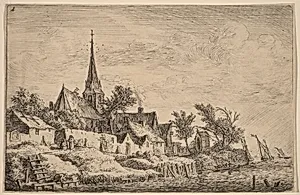
Medium
etching
Classification
Department
CG-E
Museum
National Gallery of Art, Washington, D.C.
Credit
Rosenwald Collection
Accession Number
1946.11.213
Rights
Public Domain
Art Historical Context
Nestled in the Rosenwald Collection of the National of Art, *Village Steeple at Seaside* is a etching by Dutch artist Anthonie Waterloo created sometime between 1601 and1650. Waterloo, a master of the etching medium during the Dutch Golden Age, captures a serene coastal village scene dominated by a modest church steeple rising against the horizon. The work exemplifies the period's fascination with everyday landscapes, blending humble architecture with the vast, moody sea and sky. Etching, Waterloo's preferred technique, involved drawing into a wax-coated copper plate with acid-resistant lines, then immersing it in acid to "bite" intricate details. This allowed for fine textures—like the thatched roofs, distant waves, and atmospheric haze—that brought topographical precision to intimate prints. Affordable and reproducible, etchings like this democratized art, letting collectors savor Dutch pastoral life far from the coast. As a print from the esteemed Rosenwald Collection (Department CG-E), this piece highlights the cultural bloom of 17th-century Holland, where artists elevated ordinary scenes to poetic heights, influencing later landscapists. A quiet gem for print enthusiasts, it invites visitors to ponder the harmony between human dwellings and nature's boundless edge.
About the Artist
Anthonie Waterloo · 1609–1690
Anthonie Waterloo (1609–1690) was a prominent Dutch Golden Age landscape artist, born on May 6 in Lille, then part of the Spanish Netherlands. Little is known of his early life beyond his mother, Magdalena Vaillant, who joined Amsterdam's Walloon Church in 1621, with Waterloo following in 1630; no records exist of formal training, and he was likely self-taught. Registered as a painter in Amsterdam...