
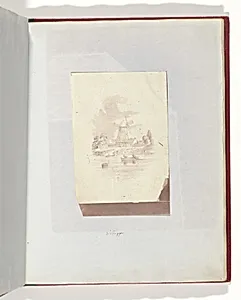
Villaggio
Medium
Salted paper print
Dimensions
15.2 x 10.1 cm (6 x 4 in.)
Classification
Photographs
Department
Photographs
Museum
Metropolitan Museum of Art, New York, NY
Credit
Harris Brisbane Dick Fund, 1936
Accession Number
36.37 (7)
Rights
Public Domain
Tags
Art Historical Context
Welcome to the Metropolitan Museum of Art's photography collection, where William Henry Fox Talbot's *Villaggio* (1839) captures the dawn of a revolutionary medium. This intimate salted paper print, measuring just 6 x 4 inches, depicts a serene Italian village landscape featuring windmills, boats, and gentle waterways—likely inspired by Talbot's travels near Lake Como. The title, meaning "village" in Italian, evokes the of everyday Mediterranean life, rendered with remarkable clarity for its time. Talbot, a British inventor and scholar, was a pioneer of photography, developing the salted paper print process in 1839 as part of his "photogenic drawing" technique. By sensitizing paper with salt and silver nitrate, he created the first negative-from-paper process, allowing multiple prints from a single exposure. Unveiled amid the 1839 rivalry with Louis Daguerre's daguerreotype, this work exemplifies early photography's shift from drawing to light-captured reality, proving paper could rival metal plates. *Villaggio* holds immense historical significance as one of Talbot's earliest surviving landscapes, showcasing photography's potential for documentary precision and artistic vision. Acquired through the Harris Brisbane Dick Fund in 1936, it invites us to marvel at how a simple village scene heralded an era that transformed art forever.
About the Artist
William Henry Fox Talbot · 1800–1877
William Henry Fox Talbot (1800–1877), a British polymath whose ingenuity transformed visual representation, was born on 11 February 1800 at Melbury House, Dorset, the only child of William Davenport Talbot of Lacock Abbey and Lady Elisabeth Fox Strangways, daughter of the 2nd Earl of Ilchester. His father died shortly after his birth, leaving the family in financial straits until his formidable mo...