
Votive Offering
1780s
Medium
Color woodblock print; two sheets of oban pentaptych
Dimensions
36.2 × 51 cm (14 5/16 × 20 1/8 in.)
Classification
woodblock print
Department
Arts of Asia
Museum
Art Institute of Chicago
Accession Number
21621
Rights
Public Domain
Art Historical Context
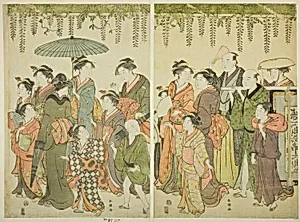
Katsukawa Shunchô *Votive Offering* (1780s) is a captivating color woodblock print from Japan's Edo period, exemplifying the ukiyo-e tradition of depicting the "floating world" of everyday life, theater, and beauty. Produced as two sheets forming part of an oban penttych—measuring 36.2 × 51 cm—this large-format work was designed to be joined with others for a panoramic scene, a technique popular among printmakers to create immersive narratives. Housed in the Art Institute of Chicago's Arts of Asia department, it reflects the booming urban culture of 18th-century Edo (modern Tokyo), where affordable woodblock prints brought art to the masses. Shunchô, a master of the Katsukawa school known for his elegant bijin-ga (images of beautiful women) and actor portraits, employed sophisticated multi-block printing. Artisans carved separate woodblocks for each color—often up to a dozen—allowing vibrant hues and subtle gradations that brought scenes to life. The oban size made it ideal for display in homes or as dedications, underscoring its dual role as art and cultural artifact. As a "votive offering," this print likely served a spiritual purpose, common in Shinto and Buddhist practices where images were dedicated at shrines for blessings or gratitude. Its preservation highlights ukiyo-e's enduring influence on global art, from Impressionism to modern design, inviting visitors to ponder the blend of devotion and artistry in everyday Japanese life.
About the Artist
Katsukawa Shunchô · 1780–1801
Katsukawa Shunchō was a Japanese designer of ukiyo-e woodblock prints active from approximately 1780 to 1795, one of the most graceful practitioners of the art of bijinga — pictures of beautiful women. He trained in the studio of Katsukawa Shunshō, the founding master of the Katsukawa School, whose pupils also included the young Hokusai. Shunshō's school was primarily known for realistic portraits...