
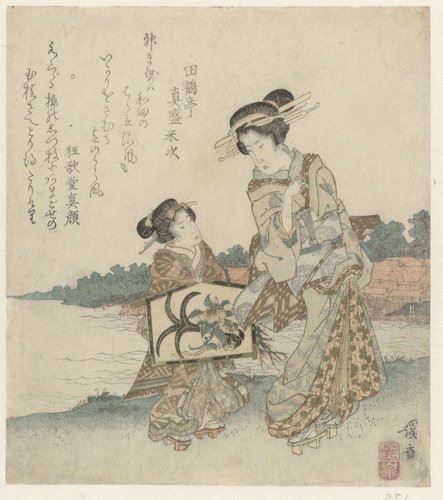
Vrouw en dienares met tempelgeschenk
c. 1820 - c. 1825
Medium
nishikie, with metallic pigments
Dimensions
202; 178
Rights
Public Domain
About this artwork
nishikie, with metallic pigments
Art Historical Context
**Vrouw en dienares metelgeschenk** (Woman and Maidservant with Offering) is a delicate ukiyo-e woodblock print by Keisai Eisen a prominent Japanese artist active during the Edo period (c. 1820–1825). Eisen, renowned for his bijin-ga—elegant depictions of beautiful women—captures a serene moment of daily life: a refined woman accompanied by her maidservant, presenting a modest gift likely for a temple visit. intimate scene reflects the "floating world" (ukiyo) culture of urban Edo (modern Tokyo), where art celebrated fleeting pleasures, fashion, and social rituals amid Japan's isolationist sakoku policy. Printed in the nishikie ("brocade picture") technique, this work exemplifies luxurious multicolored woodblock printing, enhanced by shimmering metallic pigments like mica, gold, or silver. These added a jewel-like sparkle, elevating affordable prints to collector's treasures. Measuring just 202 mm high by 178 mm wide, its compact ōban format made it ideal for personal albums or walls in modest homes, democratizing high art. Eisen's fluid lines and subtle color gradients highlight the women's kimonos and poised expressions, blending realism with idealization. As ukiyo-e bridged art and commerce, this piece offers a window into 19th-century Japanese femininity and piety, influencing global aesthetics long after Japan's borders reopened. (198 words)
About the Artist
Keisai Eisen · 1790–1848
Keisai Eisen (1790–1848), born Ikeda Yoshinobu in Edo (modern Tokyo), emerged as one of the late Edo period's most prolific ukiyo-e masters. The son of the renowned calligrapher and Kanō-school painter Ikeda Shigeharu, Eisen was immersed in the arts from childhood. He apprenticed under Kanō Hakkeisai, adopting the art name "Keisai" in homage to his teacher, and later studied bijin-ga (images of be...