
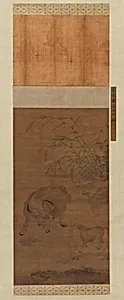
Water-buffalo and calf
1368-1644
Classification
Painting
Department
Smithsonian Collection
Museum
Smithsonian American Art Museum
Credit
Gift of Charles Lang Freer
Accession Number
F1917.333
Rights
Public Domain
Tags
About this artwork
To 1917
Art Historical Context
Behold the serene depiction of a *Water-buffalo calf*, a captivating Chinese painting from the Ming (1368–1644). This era marked a pinnacle of Chinese artistic achievement, with painters mastering subtle ink washes and delicate brushwork to evoke harmony between humans, animals, and nature. Water buffaloes, essential to rural life and rice cultivation, often symbolized diligence, fertility, and the rhythms of the agrarian world in Chinese art—here, the tender bond between mother and calf adds a layer of gentle intimacy. Though the artist remains unknown, the work exemplifies Ming aesthetics: likely rendered in traditional ink or ink-and-color on silk or paper, emphasizing economy of line and poetic restraint over realism. Such paintings were prized by literati scholars for their philosophical depth, inviting contemplation of life's cycles. A cherished piece in the Charles Lang Freer collection, it was gifted to the Smithsonian American Art Museum, reflecting Freer's passion for Asian masterpieces. Acquired by 1917, it bridges imperial China's legacy with modern appreciation, offering visitors a window into Ming-era tranquility.
About the Artist
Unknown
The artist designated as "Unknown" in our virtual museum's collection exemplifies a poignant chapter in art history: creators whose identities have faded into obscurity despite the enduring power of their work. With only one known artwork attributed to them in our holdings, this figure represents countless anonymous hands that shaped visual culture across centuries. Museums worldwide, including th...