
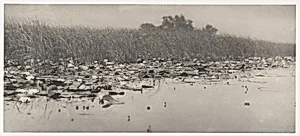
Water-Lilies
Medium
Platinum print from glass negative
Dimensions
Image: 12.3 x 28 cm (4 13/16 x 11 in.) Mount: 28.7 x 41 cm (11 5/16 x 16 1/8 in.) Sheet (Interleaving Plate Sheet): 28 x 40.8 cm (11 x 16 1/16 in.)
Classification
Photographs
Department
Photographs
Museum
Metropolitan Museum of Art, New York, NY
Credit
Gilman Collection, Purchase, Mrs. Walter Annenberg and The Annenberg Foundation Gift, 2005
Accession Number
2005.100.744
Rights
Public Domain
Tags
Art Historical Context
Peter Henry Emerson's *Water-Lilies* (1886) is a captivating platinum print from a glass negative measuring a intimate 12.3 x 28 cm. Captured as part of the burgeoning naturalistic photography movement, this serene landscape showcases delicate water lilies floating on still waters, evoking the beauty of England's marshy Broads region where Emerson often photographed. Emerson, a pioneering British photographer, championed "naturalism," advocating for images that truthfully rendered nature without artificial staging or manipulation. The platinum print medium was revolutionary for its time, prized for its expansive tonal range—from deepest blacks to luminous whites—and archival stability, allowing subtle gradations that mimicked the soft effects of painting. This technique elevated photography from mere documentation to fine art. Housed in the Metropolitan Museum of Art's Gilman Collection, *Water-Lilies* invites visitors to pause and appreciate the quiet poetry of the everyday landscape. Its horizontal composition draws the eye across the water's surface, celebrating the interplay of light and reflection in a way that feels timeless and immersive.
About the Artist
Peter Henry Emerson · 1856–1936
Peter Henry Emerson (1856–1936) was born on May 13 at his family's sugar plantation, La Palma Estate, near Encrucijada, Cuba, to an American father, Henry Ezekiel Emerson, and British mother, Jane Harris Billing. A distant relative of Ralph Waldo Emerson and Samuel Morse, he spent his early childhood amid the island's landscapes before moving to Wilmington, Delaware, during the American Civil War ...