
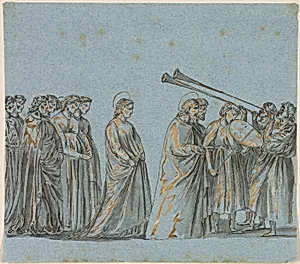
Wedding Procession of Mary and Joseph
Medium
Pen and brown ink, with brush and gray wash, heightened with lead white (oxidized), on blue laid paper, tipped on to cream wove card
Dimensions
20 × 22.8 cm (7 7/8 × 9 in.)
Classification
ink with wash
Department
Prints and Drawings
Museum
Art Institute of Chicago
Accession Number
114479
Rights
Public Domain
Art Historical Context
Giotto di Bondone, a pivotal figure in the transition from medieval to Renaissance art, created this intimate drawing of the Wedding Procession of Mary and Joseph. Active in early 14th-century Italy, Giotto is celebrated for infusing religious narratives with greater emotional depth and naturalistic observation. The scene captures a moment from the life of the Virgin Mary, likely inspired by the apocryphal stories that expanded on biblical accounts, rendered with the artist’s characteristic attention to human gesture and procession. Executed in pen and brown ink with gray wash on blue laid paper, the work demonstrates Giotto’s masterful use of light and shadow through delicate white highlights. This technique, common in early Renaissance studies, allowed artists to explore tonal values and spatial relationships before committing to larger fresco or panel projects. The small scale—roughly 20 by 23 centimeters—suggests it may have served as a preparatory sketch, offering a rare glimpse into the artist’s working process. Housed in the Art Institute of Chicago’s Prints and Drawings department, the drawing connects viewers to Giotto’s enduring influence on Western art. Its aged lead-white accents and careful composition reflect both the technical sophistication and devotional purpose that defined his era.
About the Artist
Giotto di Bondone
**Giotto di Bondone (c. 1267–1337)** was an Italian painter and architect from Florence whose groundbreaking work marked a pivotal shift in Western art during the Late Middle Ages. Born near Florence, he is widely regarded as the first major figure in the Proto-Renaissance, bridging Gothic traditions with emerging naturalism. Giotto studied under the prominent Florentine painter Cimabue, whose in...