
Wee-tá-ra-shá-ro, Head Chief of the Tribe
1834
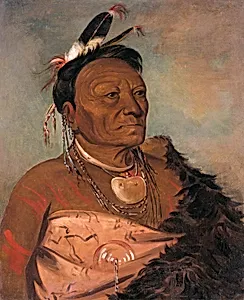
Medium
Painting
Classification
Painting
Department
Smithsonian Collection
Museum
Smithsonian American Art Museum
Credit
Smithsonian American Art Museum, Gift of Mrs. Joseph Harrison, Jr.
Accession Number
1985.66.55
Rights
Public Domain
Tags
About this artwork
“This man embraced Colonel Dodge and others of the dragoon officers in council, in his village, and otherwise treated them with great kindness, theirs being the first visit ever made to them by white people”. The subject was over ninety years old, according to George Catlin, and sat for his portrait at a Comanche village in 1834. (Catlin, 1848 Catalogue, Catlin’s Indian Gallery, SAAM online exhibition; Truettner, The Natural Man Observed, 1979)
Art Historical Context
In 1834, renowned artist George Catlin captured dignified likeness of Wee-tá-ra-shá-ro, the head chief of the Wichita tribe, in a striking bust portrait now housed at the Smithsonian American Art Museum Painted during Catlin's ambitious expedition to document Native American life across the Great Plains, this oil on canvas work exemplifies his commitment to preserving the portraits of indigenous leaders before widespread cultural disruption from white settlement. At over ninety years old, the chief sat for the painting in a Comanche village, a moment Catlin described with admiration in his 1848 catalogue. The portrait's historical significance lies in its record of early intercultural encounters. Wee-tá-ra-shá-ro warmly embraced Colonel Dodge and other U.S. Dragoon officers during their first visit by white people to his people, treating them with exceptional kindness amid tense frontier dynamics. Catlin's realistic style—marked by keen observation of facial features, traditional attire, and expressive gaze—humanizes the chief, countering stereotypes and highlighting Native sovereignty. As part of Catlin's seminal *Indian Gallery*, this piece underscores the artist's role in early ethnographic art, blending portraiture with cultural advocacy. Visitors today can appreciate how it bridges 19th-century American expansion and indigenous resilience. (198 words)
About the Artist
George Catlin · 1796–1872
George Catlin (1796–1872), born in Wilkes-Barre, Pennsylvania, to Putnam Catlin and Polly Sutton—who had been captured by Native Americans during the 1778 Battle of Wyoming—initially pursued a legal career. Trained at Litchfield Law School, he was admitted to the bar in 1819 but abandoned law after two years to study art in Philadelphia in 1823. Self-taught as a portraitist, Catlin quickly gained ...