
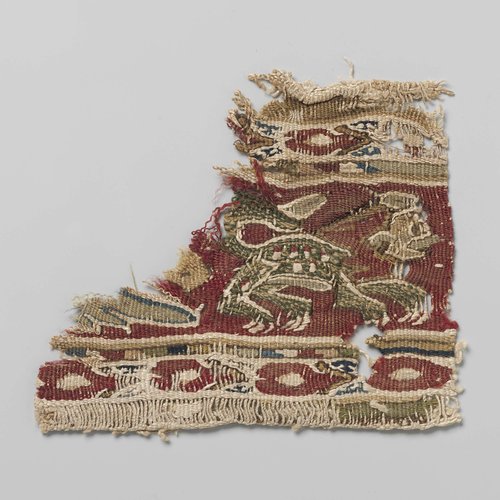
Weefselfragment in tapijtwerk
c. 500 - c. 899
Medium
tapestry
Dimensions
9.2; 11.8
Rights
Public Domain
About this artwork
Verwant motief op clavus in collectie te Trier (zie: C. Nauerth, Die koptischen Textilien der Sammlung Wilhelm Rautenstrauch im Städtischen Museum Simeonstift Trier, Trier 1989, VII.54).
Art Historical Context
This delicate tapestry fragment, titled *Weefselfragment tapijtwerk*, hails from the early medieval period (c. 500–899 CE) and measures a modest 9.2 cm high by 11.8 cm wide. Crafted anonymously, it exemplifies the exquisite textile arts of late antique Egypt, likely part of the Coptic tradition where Christian communities preserved and innovated weaving techniques inherited from Greco-Roman and Pharaonic eras. Such small survivals offer rare glimpses into daily life, clothing, and ornamental practices in a vibrant cultural crossroads. The fragment's motif bears a striking resemblance to designs on a *clavus*—a decorative purple band on tunics—preserved in the Wilhelm Rautenstrauch Collection at Trier's Simeonstift Museum (cataloged in C. Nauerth's 1989 study, VII.54). Tapestry weaving, using discontinuous wefts for patterns, was a hallmark of Coptic artistry, allowing bold colors and motifs like geometric shapes or figures to emerge from wool or linen warps. This technique not only ensured durability but also enabled portable luxury, traded across the Mediterranean. As a tiny artifact, it underscores the cultural significance of Coptic textiles: symbols of faith, status, and craftsmanship that bridged antiquity and the medieval world, influencing Byzantine and Islamic weaves. Visitors, imagine wrapping yourself in such finery amid Nile Valley markets!
About the Artist
anonymous
In the vast tapestry of art history, "Anonymous" stands not as a singular individual but as a collective designation for countless unidentified creators whose works have endured across millennia. These artists, spanning prehistoric cave painters to medieval illuminators and folk craftsmen, produced the foundational layers of human visual culture. Prior to the Renaissance, when individual fame emer...