
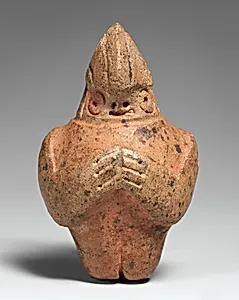
Whistle
1200–500 BCE
Medium
Ceramic
Dimensions
H. 2 1/8 × W. 1 3/8 × D. 1 1/4 in. (5.4 × 3.5 × 3.2 cm)
Classification
Ceramics-Musical Instruments
Culture
Cupisnique
Department
Arts of Africa, Oceania, and the Americas
Museum
Metropolitan Museum of Art, New York, NY
Credit
Gift of Conny and Fred Landmann, 1992
Accession Number
1992.60.1
Rights
Public Domain
Art Historical Context
This charming ceramic whistle, crafted by Cupisnique artists around 1200–500 BCE, hails from the ancient coastal region of northern Peru. Belonging to the Cupisnique culture—one of the earliest complex societies in the Andes—these small artifacts (just over 2 inches tall) exemplify the ingenuity of pre-Columbian potters. Classified as a musical instrument, it reflects how everyday objects doubled as tools for sound-making, likely used in rituals, ceremonies, or communal gatherings. Cupisnique ceramics are renowned for their expressive, often zoomorphic forms, blending human and animal features in a style influenced by the contemporary Chavín horizon. This whistle's compact dimensions suggest portability, perhaps carried by shamans or performers to invoke spirits or accompany dances. Fired in low-oxygen kilns, these vessels achieved distinctive dark slips, showcasing advanced techniques in modeling and whistle-chamber construction that produced eerie, resonant tones. Housed in The Metropolitan Museum of Art's Arts of Africa, Oceania, and the Americas department, this piece—gifted in 1992—offers a window into Cupisnique's vibrant worldview, where music intertwined with the supernatural, bridging the mortal and divine realms.