
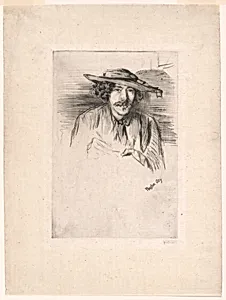
Whistler with a Hat
Medium
Drypoint with light plate tone on thin ivory Japanese paper
Dimensions
Image/plate: 22.6 × 15.1 cm (8 15/16 × 6 in.); Sheet: 24.6 × 17 cm (9 11/16 × 6 3/4 in.)
Classification
drypoint
Department
Prints and Drawings
Museum
Art Institute of Chicago
Accession Number
213620
Rights
Public Domain
Art Historical Context
"Whistler with a Hat is a captivating self-portrait etched by James McNeill Wh in 1859, the artist in a stylish boater hat with a confident gaze. Created during Whistler's early years in Paris, this intimate work reflects his burgeoning fascination with printmaking amid the etching revival of the 19th century. As an American expatriate embracing European avant-garde circles, Whistler drew inspiration from Realism and Japanese aesthetics, evident here in the elegant simplicity and subtle tonal nuances. Executed in drypoint—a direct intaglio technique where a sharp needle scratches velvety burrs into the copper plate—this print achieves a soft, painterly quality enhanced by light plate tone. Printed on thin ivory Japanese paper, prized for its absorbency and delicacy, the work showcases Whistler's innovative handling of ink and texture, allowing rich darks and luminous highlights to interplay. The modest dimensions (image: 22.6 × 15.1 cm) invite close viewing, revealing the immediacy of his experimental linework. Housed in the Art Institute of Chicago's Prints and Drawings Department, this piece highlights Whistler's pivotal role in modern printmaking, bridging 19th-century traditions with "art for art's sake" principles. It's a window into his youthful bravado and technical prowess, making it a gem for visitors exploring the evolution of portraiture.
About the Artist
James McNeill Whistler · 1834–1903
James Abbott McNeill Whistler (1834-1903) was an American-born painter and printmaker who became a leading figure in the Aesthetic Movement and pioneer of Tonalism and Japonisme. He revolutionized art by championing "art for art's sake" and treating paintings as visual equivalents of musical compositions, titling works as "arrangements," "harmonies," and "nocturnes" to emphasize formal qualities o...