
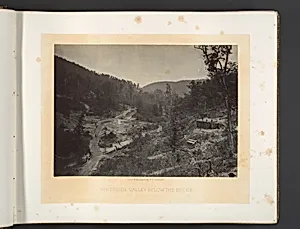
Whiteside Valley Below the Bridge
1860s
Medium
Albumen silver print from glass negative
Classification
Photographs
Department
Photographs
Museum
Metropolitan Museum of Art, New York, NY
Credit
Pfeiffer and Rogers Funds, 1970
Accession Number
1970.525 (5)
Rights
Public Domain
Tags
Art Historical Context
**Whiteside Valley Below the Bridge** (1860s) is a striking albumen silver print from a glass negative by George N Barnard, capturing the serene yet poignant landscape of Whiteside Valley in Tennessee, viewed from below a bridge. Barnard's keen eye for topography and light renders the rolling hills, river, and distant ridges with remarkable clarity, evoking the untouched beauty of the American South amid wartime turmoil. As an official photographer for General William T. Sherman's campaigns during the Civil War, Barnard documented key sites along the Atlanta Campaign and March to the Sea. This image, from the 1860s, likely records a strategic valley near Chattanooga, a hotspot of Union advances. It stands as a testament to early war photography, blending natural splendor with the shadow of conflict—few human figures appear, emphasizing the land's quiet endurance. The albumen process, popular in the mid-19th century, produced richly toned prints with fine detail from glass negatives, making Barnard's work enduringly vivid. Acquired by The Metropolitan Museum of Art through the Pfeiffer and Rogers Funds in 1970, this photograph invites visitors to reflect on how landscapes bore witness to history's pivotal moments.
About the Artist
George N. Barnard · 1819–present
George N. Barnard (1819–1902) was a pioneering American photographer whose six-decade career spanned the dawn of the medium, from daguerreotypes to Civil War documentation. Born into a farming family in Coventry, Connecticut, on December 23, 1819, he lost his father at age seven and apprenticed in family businesses before marrying in 1843 and relocating to Oswego, New York. There, he launched one ...