
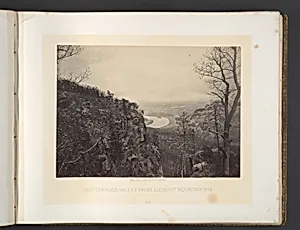
Chattanooga Valley from Lookout Mountain No. 2
1860s
Medium
Albumen silver print from glass negative
Classification
Photographs
Department
Photographs
Museum
Metropolitan Museum of Art, New York, NY
Credit
Pfeiffer and Rogers Funds, 1970
Accession Number
1970.525 (14)
Rights
Public Domain
Tags
Art Historical Context
George N. Barnard’s “Chattanooga Valley from Lookout Mountain No. 2,” created in the 1860s, captures the sweeping American landscape through the lens of early photography. As an albumen silver print made from a glass negative, the work exemplifies the wet-collodion process that dominated mid-nineteenth-century image-making, allowing photographers to produce remarkably detailed and tonal prints on paper. Barnard’s composition draws the viewer across layered ridges and valleys, emphasizing both the grandeur of the terrain and the quiet stillness of the scene. This photograph reflects the growing artistic ambition of landscape photography during the 1860s, when practitioners began treating the camera as a tool for both documentation and aesthetic expression. The albumen process, prized for its rich contrast and fine detail, helped elevate photography from a novelty to a respected medium collected by institutions such as the Metropolitan Museum of Art. Today the print stands as a testament to Barnard’s skill in translating vast natural spaces onto a two-dimensional surface. Acquired through the Pfeiffer and Rogers Funds in 1970, the image invites visitors to consider how nineteenth-century photographers shaped public perceptions of the American wilderness. Its presence in the museum’s photographs collection underscores the enduring cultural value of these early landscapes.
About the Artist
George N. Barnard · 1819–present
George N. Barnard (1819–1902) was a pioneering American photographer whose six-decade career spanned the dawn of the medium, from daguerreotypes to Civil War documentation. Born into a farming family in Coventry, Connecticut, on December 23, 1819, he lost his father at age seven and apprenticed in family businesses before marrying in 1843 and relocating to Oswego, New York. There, he launched one ...