
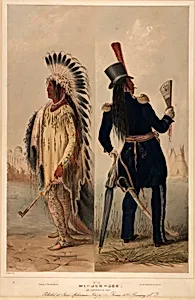
Wi-jun-jon. An Assinneboin Chief.
n.d.
Medium
Graphic Arts-Print
Classification
Graphic Arts-Print
Department
Smithsonian Collection
Museum
Smithsonian American Art Museum
Credit
Smithsonian American Art Museum, Gift of Mrs. Joseph Harrison, Jr.
Accession Number
1966.48.70
Rights
Public Domain
Tags
Art Historical Context
**Wi-jun-jon, An Assiniboine Chief** is a striking portrait print by George Catlin, the pioneering 19th-century American artist renowned for his documentation of Native American life. Captured in the graphic arts medium, this undated work from the Smithsonian American Art Museum's collection immortalizes Wi-jun-jon, a prominent chief of the Assiniboine (also spelled Assinneboin) people. Catlin's portraits, often created during his extensive travels along the Missouri River in the 1830s, aimed to preserve the dignity and vanishing traditions of Indigenous tribes before widespread Euro-American influence. As a print, this piece reflects Catlin's innovative approach to sharing his observations widely through reproductions, making Native imagery accessible beyond oil paintings. His Romantic style emphasized the noble features and regalia of his subjects, countering stereotypes with vivid realism. Wi-jun-jon's portrayal highlights Assiniboine cultural identity, showcasing intricate attire that symbolized leadership and heritage. Housed in the Smithsonian thanks to a generous gift from Mrs. Joseph Harrison, Jr., this print underscores the museum's commitment to American art and Indigenous representation. It invites visitors to reflect on a pivotal era of cultural encounter, celebrating Catlin's legacy as a visual chronicler of Native resilience.
About the Artist
George Catlin · 1796–1872
George Catlin (1796–1872), born in Wilkes-Barre, Pennsylvania, to Putnam Catlin and Polly Sutton—who had been captured by Native Americans during the 1778 Battle of Wyoming—initially pursued a legal career. Trained at Litchfield Law School, he was admitted to the bar in 1819 but abandoned law after two years to study art in Philadelphia in 1823. Self-taught as a portraitist, Catlin quickly gained ...