
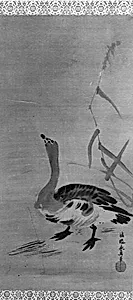
Wild Goose and Reeds
Medium
Hanging scroll; ink on silk
Dimensions
Image: 32 3/8 × 15 15/16 in. (82.3 × 40.5 cm) Overall with mounting: 73 1/4 × 21 7/16 in. (186 × 54.5 cm) Overall with knobs: 73 1/4 × 23 7/16 in. (186 × 59.5 cm)
Classification
Paintings
Culture & Period
Japan · Edo period (1615–1868)
Department
Asian Art
Museum
Metropolitan Museum of Art, New York, NY
Credit
The Howard Mansfield Collection, Purchase, Rogers Fund, 1936
Accession Number
36.100.93
Rights
Public Domain
Tags
Art Historical Context
### Wild Goose and Reeds Kano Yasunobu's *Wild Goose and Reeds* is a captivating hanging scroll from Japan's Edo period (1615–8), rendered in delicate ink on silk. Measuring over six feet tall when fully mounted, this work belongs to the prestigious Kano school, a dynasty of professional painters who served the shogunate with their bold, decorative style. Yasunobu (1614–1685), a key figure in this lineage, masterfully evokes nature's quiet drama through minimalist composition, showcasing the school's signature fluid brushwork and rhythmic lines. The solitary wild goose amid swaying reeds captures an iconic autumn motif in Japanese art, symbolizing seasonal transience and serene solitude—hallmarks of Edo-era aesthetics influenced by Zen Buddhism. Hanging scrolls like this were not everyday decor but treasures unrolled for special occasions, such as tea gatherings, transforming a room into a meditative space. Housed in The Metropolitan Museum of Art's Asian Art collection, thanks to The Howard Mansfield Collection, this painting highlights the Kano school's enduring impact on Japanese painting, blending technical virtuosity with poetic restraint. A perfect invitation to pause and appreciate nature's subtle poetry.
About the Artist
Kano Yasunobu (Japanese) · 1614 –1685
Japanese, 1614–1685