
William W. Welch
c. 1837
Medium
Oil on canvas
Dimensions
64.8 × 54.6 cm (25 1/2 × 21 1/2 in.)
Classification
painting
Department
Arts of the Americas
Museum
Art Institute of Chicago
Accession Number
181339
Rights
Public Domain
About this artwork
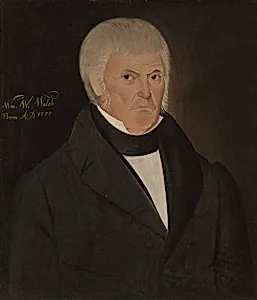
Sheldon Peck rendered the distinctive likenesses of his two sitters, William and Phebe Welch, using hard-edged lines and modeled forms (see Phebe Russell Swain Welch, 1990.100.2). Amid a dark setting, the couple’s intense gazes hold our attention. Their names and dates of birth are inscribed in golden yellow paint, emphasizing their identities. The Welches were among the white settler-colonialists who established homesteads in Illinois in the early 19th century. Beginning in 1834, they lived nea...
Art Historical Context
Sheldon Peck's *William W. Welch* (c. 1837 is a compelling example of early 19th-century American portraiture, housed in the Art Institute of Chicago's of the Americas collection. This oil-on-canvas painting, measuring 64.8 × 54.6 cm, captures the in a direct, unflinching gaze typical of the era's itinerant artists. Peck, a self-taught painter active in New England and the Midwest, specialized in affordable likenesses for middle-class families blending practicality with artistic expression. Painted during the antebellum period, the work reflects the growing democratization of portraiture in America. As the young nation expanded, oils like this preserved personal and family legacies amid rapid social change. Peck's folk style—marked by flattened forms, bold outlines, and vivid colors—eschews European academic polish for a raw, authentic charm, emphasizing the subject's dignified presence over idealization. This intimate-scale portrait underscores the cultural role of such artworks: not just decoration, but vital records of everyday Americans. Visitors today can appreciate how Peck's technique made fine art accessible, bridging folk tradition and emerging national identity.