
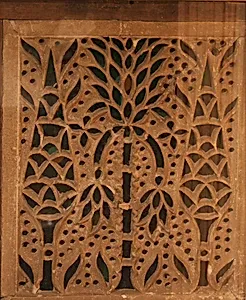
Window
Unknown Artist
18th century
Medium
Gypsum, stained glass
Dimensions
Window without wood frame: H. 16 3/8 in. (41.6 cm) W. 16 1/2 in. (41.9 cm) D. 1 1/8 in. (2.9 cm) Window with wood frame: H. 23 in. (58.4 cm) W. 19 3/4 in. (50.2 cm) D. 1 5/8 in. (4.1 cm)
Classification
Glass
Department
Islamic Art
Museum
Metropolitan Museum of Art, New York, NY
Credit
Gift of William R. Ware, 1893
Accession Number
93.26.9
Rights
Public Domain
Art Historical Context
This delicate 18th-century window crafted from gypsum and stained glass, exemplifies the refined artistry of Islamic decorative traditions. Measuring just over 16 inches square without its wooden frame, it likely served as a small architectural element—perhaps in a mosque, palace, private residence—designed to filter sunlight into vibrant patterns. The combination of gypsum, a versatile plaster often molded into intricate frames, with colored stained glass highlights the technical ingenuity of Islamic craftsmen, who achieved luminous effects without figurative imagery, adhering to aniconic principles. In the Islamic world of the 18th century, such windows transformed interiors with kaleidoscopic light, symbolizing divine illumination and spiritual transcendence. Stained glass techniques, involving pot-metal coloring or enamel painting, allowed for bold geometries, arabesques, and floral motifs that danced across walls and floors. Though the artist remains unknown, this piece reflects the era's emphasis on optical beauty and mathematical precision, common in regions from the Ottoman Empire to Persia. A generous gift to the Metropolitan Museum of Art from William R. Ware in 1893, this window invites visitors to imagine the play of light in a sunlit harem or prayer hall, offering a tangible glimpse into Islamic architectural splendor.