
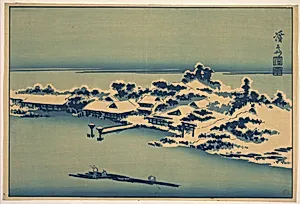
Winter Landscape
Medium
Woodblock print; ink and color on paper
Dimensions
10 x 15 in. (25.4 x 38.1 cm)
Classification
Prints
Culture & Period
Japan · Edo period (1615–1868)
Department
Asian Art
Museum
Metropolitan Museum of Art, New York, NY
Credit
Purchase, Joseph Pulitzer Bequest, 1918
Accession Number
JP554
Rights
Public Domain
Tags
Art Historical Context
Step into the serene chill of *Winter Landscape*, a captivating woodblock print by Keisai Eisen, a master of Japan's Edo period (1615–1868). Created in an unknown year, this 10 x 15-inch ink and color on paper work evokes the quiet beauty of a snow-draped scene, blending delicate whites with subtle hues to capture winter's tranquil hush. Housed in the Metropolitan Museum of Art Asian Art Department—acquired through the Joseph Pulitzer Bequest 1918—it exemplifies the ukiyo-e tradition, or "pictures of the floating world," which celebrated everyday poetry amid urban Japan's vibrant culture. Eisen, active in the early 19th century, was renowned for his refined depictions of landscapes and beauties, drawing from the elegant lines of his teacher, Kikugawa Eizan. Woodblock printing revolutionized art accessibility: intricate designs were carved into wooden blocks, inked, and hand-printed in multiple colors, allowing mass production for merchants and commoners. This technique's precision shines in Eisen's handling of snow's texture and atmospheric depth, turning nature's starkness into meditative elegance. As a cultural snapshot of Edo-era Japan, *Winter Landscape* reflects seasonal reverence in Japanese aesthetics—winter symbolizing purity and impermanence. Pause here to appreciate how Eisen's print bridges artistry and daily life, inviting us to savor the fleeting magic of a snowy world.
About the Artist
Keisai Eisen · 1790–1848
Keisai Eisen (1790–1848), born Ikeda Yoshinobu in Edo (modern Tokyo), emerged as one of the late Edo period's most prolific ukiyo-e masters. The son of the renowned calligrapher and Kanō-school painter Ikeda Shigeharu, Eisen was immersed in the arts from childhood. He apprenticed under Kanō Hakkeisai, adopting the art name "Keisai" in homage to his teacher, and later studied bijin-ga (images of be...