
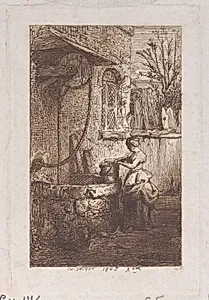
Woman at a Well
1842
Medium
Etching
Dimensions
Sheet (Trimmed): 4 1/8 × 3 1/16 in. (10.5 × 7.8 cm) Plate: 3 15/16 × 2 9/16 in. (10 × 6.5 cm)
Classification
Prints
Department
Drawings and Prints
Museum
Metropolitan Museum of Art, New York, NY
Credit
The Elisha Whittelsey Collection. The Elisha Whittelsey Fund, 1963
Accession Number
63.625.415
Rights
Public Domain
Tags
Art Historical Context
**Woman at a Well**, a delicate etching by French artist Charles Jacque from 1842, captures quiet moment of rural life. Measuring just under 4 by 3 inches, this intimate print depicts a woman drawing water from a well, a scene rich with everyday authenticity. Jacque, a key figure in the Barbizon School drew inspiration from the French countryside near Fontainebleau, favoring unidealized portrayals of peasants and nature over romantic grandeur. Etching, Jacque's chosen medium, showcases his mastery of intaglio techniques: lines incised into a metal plate with acid create fine, expressive textures that evoke the roughness of stone and the flow of water. This process allowed artists like Jacque to produce detailed, reproducible works that democratized art, bridging fine art and popular imagery during the 19th century's rise of Realism. Housed in the Metropolitan Museum of Art's Drawings and Prints department as part of The Elisha Whittelsey Collection, this piece highlights the cultural role of women in agrarian society and Jacque's contribution to printmaking's golden age. A charming window into 1840s rural France, it invites us to pause and appreciate the poetry in the mundane.
About the Artist
Charles Jacque · 1813–1894
Charles-Émile Jacque (1813–1894) was a pioneering French painter, engraver, and illustrator whose career bridged the worlds of printmaking and pastoral painting. Born in Paris amid a difficult childhood, he apprenticed at age seventeen to a map engraver, mastering drypoint technique and producing his first etching in 1830—a copy of a head after Rembrandt. After serving seven years in the French Ar...