
Woman at Toilette
1868
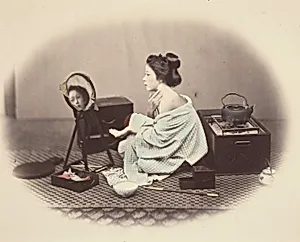
Medium
albumen print with applied color
Dimensions
sheet (trimmed to image): 20.3 x 25.4 cm (8 x 10 in.) page size: 35 x 48 cm (13 3/4 x 18 7/8 in.)
Classification
Photograph
Department
CPH
Museum
National Gallery of Art, Washington, D.C.
Credit
Gift of Ken and Kiyo Hitch in memory of Harry Lunn, Jr.
Accession Number
1999.37.1
Rights
Public Domain
Art Historical Context
In 1868, Beato, a pioneering British-Italian photographer renowned for his vivid documentation of Asia, captured *Woman at Toilette* his time in Japan amid the transformative Meiji Restoration. Beato, who arrived in Yokohama in 1863, specialized in albumen prints—early photographic processes using egg-white-coated paper for exceptional tonal depth and detail. He often enhanced these with hand-applied color, bridging photography's realism with painting's allure to captivate Western audiences fascinated by Japan's opening to the world. This intimate portrait depicts a Japanese woman at her dressing table, embodying Beato's signature blend of ethnography and artistry. His works humanized exoticized subjects, offering glimpses into daily life—geisha preparations, samurai customs—while subtly staging scenes for aesthetic impact. The applied color adds a jewel-like vibrancy, heightening cultural intrigue during an era of rapid modernization. Housed in the National Gallery of Art's photography collection (gift of Ken and Kiyo Hitch in memory of Harry Lunn, Jr.), this 20.3 x 25.4 cm trimmed print exemplifies 19th-century photo-pictorialism. It invites visitors to ponder how Beato's lens preserved vanishing traditions, making history feel vividly present.
About the Artist
Felice Beato · 1832–1909
Felice Beato (c. 1832–1909), an Italian-born photographer who became a British subject through his family's residence on the British protectorate island of Corfu, emerged as one of the pioneering figures in war and travel photography. Born in Venice or Corfu to a Venetian noble family with roots in Corfu, Beato's early life remains somewhat obscure, but he acquired his first photographic lens in P...