
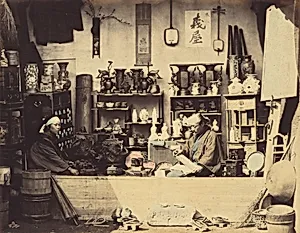
Curio Shop
c. 1865
Medium
albumen print with applied color
Dimensions
image/sheet: 20 × 25.3 cm (7 7/8 × 9 15/16 in.)
Classification
Photograph
Department
CPH
Museum
National Gallery of Art, Washington, D.C.
Credit
Pepita Milmore Memorial Fund
Accession Number
2017.70.1
Rights
Public Domain
Art Historical Context
Step into the bustling world of mid-19th-century Japan Felice Beato's *Curio Shop* (c. 1865), a captivating albumen print hand-colored with applied pigments. This 20 × 25.3 cm photograph captures quaint storefront brimming with eclectic treasures—porcelain, fans, and trinkets—that enticed Western visitors during Japan's rapid opening to the world after the 1853 arrival of Commodore Perry's "Black Ships." Beato a pioneering British-Italian photographer, arrived in Yokohama in 1863, where he established one of the first studios producing souvenir images for tourists and diplomats. His work documents the Meiji-era transition, blending traditional Japanese life with emerging global commerce. The albumen print process, using egg whites to bind light-sensitive silver salts, produced sharp, luminous details, while the delicate hand-coloring added vivid realism, mimicking ukiyo-e woodblock prints and heightening appeal for collectors. Housed in the National Gallery of Art through the Pepita Milmore Memorial Fund, this piece highlights photography's role in bridging East and West, preserving fleeting scenes of cultural exchange amid Japan's modernization. A window into an era of curiosity and curiosity shops alike!
About the Artist
Felice Beato · 1832–1909
Felice Beato (c. 1832–1909), an Italian-born photographer who became a British subject through his family's residence on the British protectorate island of Corfu, emerged as one of the pioneering figures in war and travel photography. Born in Venice or Corfu to a Venetian noble family with roots in Corfu, Beato's early life remains somewhat obscure, but he acquired his first photographic lens in P...