
Woman Picking Fruit and Oviri
1895/96
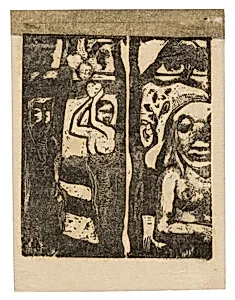
Medium
Wood-block print in black ink on thin ivory Japanese paper, tipped on ivory wove paper, laid down on off-white wove plate paper with decorative plate marks
Dimensions
Image: 10.5 × 9 cm (4 3/16 × 3 9/16 in.); Sheet: 14.4 × 11.1 cm (5 11/16 × 4 3/8 in.)
Classification
woodcut
Department
Prints and Drawings
Museum
Art Institute of Chicago
Accession Number
52990
Rights
Public Domain
Art Historical Context
In the mid-1890s, Paul Gauguin, a Post-Impressionist artist immersed himself in Tahiti, drawing inspiration from Polynesian culture to escape European conventions. Created around 1895–96, *Woman Picking Fruit and Oi* captures this exotic allure through a intimate woodcut print. The title evokes a sereneesian scene: a woman gathering fruit alongside Oviri, Gauguin's iconic symbol of primal femininity derived from Tahitian mythology, blending everyday life with mythic power. This small-scale work (just 10.5 × 9 cm) exemplifies Gauguin's innovative printmaking during his Tahitian sojourn. Printed in bold black ink on delicate ivory Japanese paper—tipped onto thicker supports with decorative plate marks—it reflects his admiration for ukiyo-e woodcuts by artists like Hokusai. Gauguin carved the blocks himself, embracing a raw, flattened style with stark contrasts and simplified forms that prioritized emotional and symbolic depth over realism. This technique not only democratized his art but also bridged Eastern precision with Western Symbolism. Housed in the Art Institute of Chicago's Prints and Drawings department, this rare woodcut offers a window into Gauguin's quest for "primitive" authenticity, influencing modern artists like the Fauves and Expressionists. Visitors, marvel at how its modest size packs a profound cultural dialogue!
About the Artist
Paul Gauguin · 1848–1903
Paul Gauguin (1848-1903) was a French Post-Impressionist painter whose bold experiments with color, form, and subject matter made him one of the most influential figures in the transition from 19th-century art to modernism. His rejection of European civilization for the perceived authenticity of 'primitive' cultures established an archetype of artistic exile that continues to resonate. Gauguin's ...