
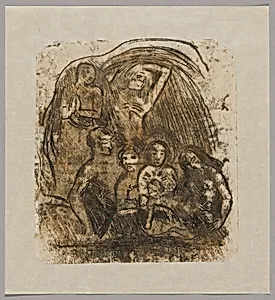
Nativity (Mother and Child Surrounded by Five Figures)
c. 1902
Medium
Transfer drawing in brown and black ink (recto) and graphite and red chalk (verso) on cream wove paper trimmed and perimeter mounted on cream laid paper
Dimensions
24.4 × 22.1 cm (9 5/8 × 8 3/4 in.)
Classification
monotype
Department
Prints and Drawings
Museum
Art Institute of Chicago
Accession Number
20172
Rights
Public Domain
Art Historical Context
In the Prints and Drawings department of the Institute of Chicago resides a poignant late work by Paul Gauguin: *Nativity (Mother and Surrounded by Five Figures, created around 1902. This intimate monotype measures 24.4 × 22.1 cm and a transfer drawing in brown and black ink on recto, with graphite and red chalk sketches on verso, all on cream wove paper on laid paper. Gauguin, a Post-Impressionist pioneer famous for his vivid Tahitian scenes and rejection of Western conventions, produced this during his final years in the Marquesas Islands, where he sought spiritual purity amid Polynesian culture. The composition centers a tender mother and child—echoing the Christian Nativity—encircled by five enigmatic figures, blending sacred European iconography with Gauguin's stylized, flattened forms and symbolic simplicity. This rare monotype technique, involving inked pressure transfers from a plate, allowed unique, painterly effects impossible in traditional prints, highlighting his innovative printmaking in exile. As one of Gauguin's scarce late drawings, it reveals his enduring fascination with primal themes of birth and divinity, bridging his Parisian Symbolist roots with exotic mysticism—a testament to an artist who lived fiercely until his death in 1903.
About the Artist
Paul Gauguin · 1848–1903
Paul Gauguin (1848-1903) was a French Post-Impressionist painter whose bold experiments with color, form, and subject matter made him one of the most influential figures in the transition from 19th-century art to modernism. His rejection of European civilization for the perceived authenticity of 'primitive' cultures established an archetype of artistic exile that continues to resonate. Gauguin's ...