
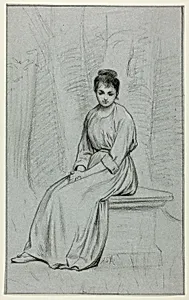
Woman Resting on Stone Bench
Medium
Black pastel, with touches of white pastel, on blue laid paper
Dimensions
40 × 25 cm (15 3/4 × 9 7/8 in.)
Classification
pastel
Department
Prints and Drawings
Museum
Art Institute of Chicago
Accession Number
46925
Rights
Public Domain
Art Historical Context
### Woman Resting on Stone Bench Nestled in the Art Institute of Chicago's Prints Drawings collection, *Woman Resting on Stone Bench* by Henry Marks (1829–1898) offers a quiet glimpse into Victorian-era figural intimacy. Marks, a Royal Academician celebrated for his humorous "parrot pictures"—whimsical scenes of birds mimicking human antics—demonstrates his versatility here in a tender, undated study. Rendered in black pastel with subtle white highlights on blue laid paper (40 × 25 cm), the work captures a woman in repose, her form emerging softly from the textured support. Pastel was a favored medium in the 19th century for its direct, painterly effects, allowing artists like Marks to blend tones fluidly and achieve luminous depth without brushes. The blue laid paper, with its visible chain lines from traditional handmade production, provides a cool mid-tone ground that enhances the figure's contours and the stone bench's rugged surface—techniques evoking the preparatory sketches of Old Masters while aligning with Victorian interests in everyday poetry. This compact drawing highlights Marks's skill in observation and light, bridging his lively genre scenes with more contemplative portraiture. It invites museum visitors to pause, much like the subject, appreciating the artistry in fleeting moments of rest.
About the Artist
Henry Stacy Marks · 1829–1898
Henry Stacy Marks (1829–1898) was born on 13 September 1829 in London, the fourth child of coachbuilder John Isaac Marks and Elizabeth Pally. Initially apprenticed in his father's trade and briefly working as a clerk, Marks displayed early artistic talent, learning to paint heraldry for carriages. He began formal training around 1847 at James Mathews Leigh's art school in Newman Street, where he b...