
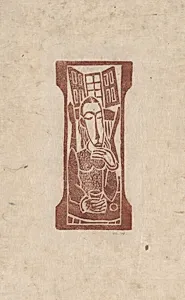
Woman Seated at Table
1919-1920
Medium
woodcut in brown on laid paper
Dimensions
image: 10.64 × 4.92 cm (4 3/16 × 1 15/16 in.) sheet: 35.56 × 22.07 cm (14 × 8 11/16 in.)
Classification
Department
CG-W
Museum
National Gallery of Art, Washington, D.C.
Credit
Gift of Jack and Margrit Vanderryn
Accession Number
2015.114.43
Rights
Public Domain
Art Historical Context
Behold Max Weber's intimate woodcut *Woman Seated at Table* (1919–1920), a delicate gem printed in earthy brown ink on laid paper Measuring a mere 10.64 × 4.92 cm for the image—set against a larger 35.56 × 22.07 cm sheet—this print invites visitors to lean in close, savoring its crisp lines and subtle textures. Housed in the National Gallery of Art's collection through the generous gift of Jack and Margrit Vanderryn, it exemplifies Weber's mastery of the woodcut medium, a labor-intensive relief process where the artist carves directly into wood blocks to create bold, graphic contrasts. Max Weber (1881–1961), a Russian-born American modernist, bridged European avant-garde influences like Cubism with his own rhythmic abstractions. By the late 1910s, amid post-World War I introspection, he turned to printmaking to distill everyday scenes into essential forms. The woodcut's stark simplicity here highlights the woman's poised figure at the table, evoking quiet domesticity with angular contours and minimal detail—hallmarks of early 20th-century modernism. This modest yet powerful work underscores printmaking's democratic appeal, allowing broad dissemination of modernist ideas. Its laid paper, with visible chain lines, nods to traditional craftsmanship, blending old techniques with forward-thinking vision. A perfect pause for reflection in our virtual gallery!
About the Artist
Max Weber · 1881–1961
Max Weber (1881–1961), born in Białystok in the Russian Empire (now Poland) to Orthodox Jewish parents, immigrated to Brooklyn, New York, at age ten with his family, joining his tailor father.) There, he pursued art studies at the Pratt Institute under Arthur Wesley Dow, an innovative teacher who emphasized expression and form over traditional narrative, drawing from Japanese art and Paul Gauguin....