
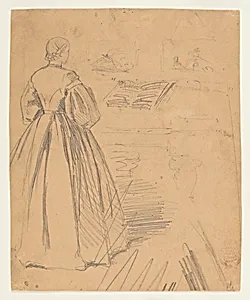
Woman Standing Before a Piano
Classification
figures
Department
Smithsonian Collection
Museum
Smithsonian American Art Museum
Credit
Gift of Charles Savage Homer, Jr.
Accession Number
1912-12-95
Rights
Public Domain
About this artwork
Research in Progress
Art Historical Context
**Woman Standing Before a Piano** (1862) by Winslow Homer captures a quiet moment in American domestic life during the early years of the Civil War. Painted when Homer was just 26, this work reflects his beginnings as a rising artist who had recently transitioned from commercial illustration for *Harper's Weekly*—where he sketched battlefield scenes—to exploring intimate genre subjects. The title evokes a poised female figure in an everyday interior, emblematic of the era's middle-class parlors where pianos symbolized refinement and leisure amid national turmoil. Homer, a foundational figure in American Realism, excelled at portraying ordinary people with unflinching honesty and subtle emotional depth. Though the medium remains unidentified, his early pieces often used oil or watercolor to render light and texture with precision, foreshadowing his later mastery of dramatic seascapes and rural narratives. Classified under "figures" in the Smithsonian American Art Museum's collection, it highlights his skill in composing solitary subjects that invite viewers to ponder unspoken stories. A poignant family connection enhances its allure: gifted by Homer's brother, Charles Savage Homer, Jr., this piece underscores the artist's personal ties. With research ongoing, it invites fresh discoveries about Homer's evolving vision during a pivotal time in U.S. history, reminding us how art preserves the rhythms of life even in uncertain times.