
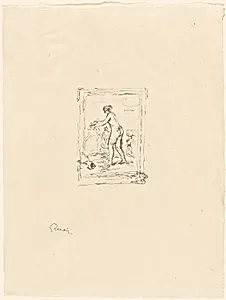
Woman with Grapevine, 2nd variant
c. 1904, published 1919
Medium
Lithograph in black on ivory Japanese paper
Dimensions
Image: 11.8 × 8.5 cm (4 11/16 × 3 3/8 in.); Sheet: 35.5 × 26.9 cm (14 × 10 5/8 in.)
Classification
lithograph
Department
Prints and Drawings
Museum
Art Institute of Chicago
Accession Number
90400
Rights
Public Domain
Art Historical Context
In the gentle glow of Pierre-Auguste Renoir's late oeuvre, *Woman with Grapevine, 2nd variant* (c. 1904, published 1919) captures the artist's enduring fascination with the female form. As a cornerstone of French Impressionism, Renoir shifted in his later years toward printmaking amid health challenges like arthritis, producing intimate lithographs that echoed his luminous oil paintings. This work, housed in the Art Institute of Chicago's Prints and Drawings department, depicts a woman entwined with grapevines, evoking themes of abundance and sensuality rooted in classical motifs. Printed in black ink on luxurious ivory Japanese paper—a medium prized for its soft texture and superior ink absorption—this lithograph measures a modest image size of 11.8 × 8.5 cm. The technique allowed Renoir to mimic his signature fluid brushstrokes, blending drawn lines with tonal gradations for a painterly depth despite its monochrome palette. Published posthumously in 1919, this second variant highlights the meticulous editions common in early 20th-century printmaking, preserving Renoir's touch for wider audiences. For visitors, this petite gem offers a window into Renoir's twilight creativity, where everyday elegance meets artistic innovation, reminding us of his lifelong celebration of beauty in the human figure.
About the Artist
Pierre-Auguste Renoir · 1841–1919
Pierre-Auguste Renoir (1841-1919) was a founding figure of Impressionism whose luminous depictions of Parisian leisure, sensuous female forms, and sun-dappled landscapes made him one of the most beloved painters in Western art history. Born in Limoges to a working-class family, Renoir began as a porcelain painter before pursuing fine arts, and this early craft experience gave him facility with the...